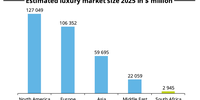
Luxity’s latest State of the Luxury Market in Africa report shows a decisive change in how South Africans buy high-end goods. Bags, jewellery and watches are in. Shoes, wallets and overhyped items are out.
The luxury consumer has not disappeared, but has simply become harder to impress. For years, conspicuous branding ruled the luxury retail market of South Africa. Big logos signalled success and belonging.
Now, among those who still browse Louis Vuitton bags or Gucci watches, the calculation has become more complex because the loudest logo is no longer the safest purchase. According toLuxity’s State of the Luxury Market in Africa 2025 report, South Africa’s luxury sector is undergoing what can only be described as a coming of age. After years of expansion, the broader luxury market stabilised in 2025, shrinking slightly by 1% year on year, according to the Clur Shopping Index.
Read Full Article on Daily Maverick
[paywall]
The pre-owned market moved in the opposite direction. Luxity, Africa’s largest pre-owned luxury reseller, grew by 27.86% between 2024 and 2025, extending its total growth since 2019 to more than 594%. South Africans are not buying less luxury.
They are buying better and smarter. “This really [speaks] to the rise of what we call the ‘savvy consumer’,” Michael Zahariev, co-founder of Luxity, told Daily Maverick. “They’re really researching and they’re not just making a decision based on ‘this is my style’ or ‘this is my affordability range’.
They’re really looking at the long-term value of a product.” How different luxury categories perform gives one insight into this change that’s under way. Luxity’s data showed that interest in jewellery surged by 43.8% in 2025, while bags grew by 14.6%. In an unstable economic climate, certain luxury goods are being treated as stores of value.
Watches, in particular, are behaving like alternative assets. Rolex resold at an average of 126.5% of retail price in South Africa, up more than 20% year on year. Cartier retained 72.6% of its value, while Hermès held at 67.8%.
“Consumers have started to realise that certain categories resell better than others,” Zahariev said. “Jewellery and bags in particular, if you bought them pre-owned and you wanted to sell them in a couple years, you would get a much higher amount of money back or sometimes even a return on what you originally paid.” Louis Vuitton and Gucci still dominate awareness, but their combined share of search interest dropped from roughly 30% in 2024 to 21.5% in 2025. Smaller designer houses like Bulgari, Givenchy and Montblanc gained traction.
[/paywall]
