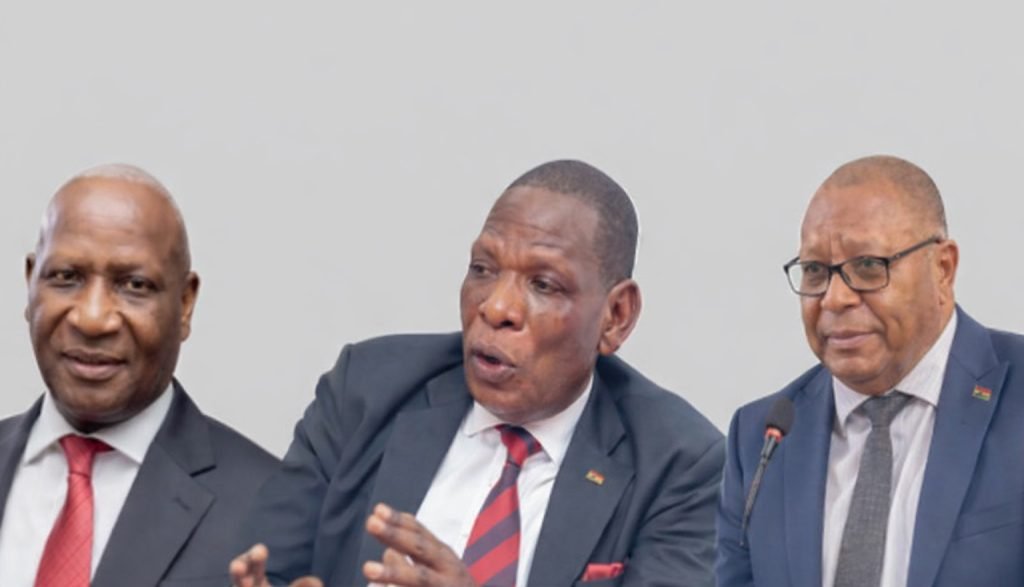
Five months into President Peter Mutharika’s return to office, his key economic appointments signal a clear reliance on corporate experience to stabilise the economy and improve public-sector performance. Through the appointments of Joseph Mwanamvekha as Minister of Finance, Economic Planning and Decentralisation, George Partridge as Governor of the Reserve Bank of Malawi (RBM) and Symon Itaye as Minister of Industrialisation, Business, Trade and Tourism (MIBTT), the President has assembled an economic core shaped as much by boardrooms as by the traditional public service, especially in the case of the Treasury boss and the new top central banker. Itaye, a former chief executive officer of Nampak Limited and sits on boards of several corporate entities, was drafted into Cabinet on Friday to replace Partridge who a week earlier was appointed RBM Governor.
While roping in Itaye, the President also swapped Minister of Natural Resources Alfred Gangata with Minister of Sports, Youth and Culture Patricia Wiskes. From the appointments of Mwanamvekha, Patridge and now Itaye, the message appears deliberate. The appointments come on the backdrop of weak economic growth, inefficient spending, unsustainable public debt levels, persistent foreign-exchange shortages and underperforming State-owned enterprises (SOEs), among other factors that have sunk the local economy.
Mutharika seems to believe that execution of discipline—cost control, performance management and rapid decisiveness—can be imported from the private sector into public institutions that have long struggled to deliver. However, the analysts The Nation interviewed over the weekend caution that leadership quality alone is insufficient without structural and political support. Leadership and corporate governance expert Jimmy Lipunga stated: “Any corrective reform will introduce discomfort and political backlash.
[paywall]
This is when the temptation for political interference is greatest and when credible reforms are most likely to be reversed.” Lipunga is a former CEO of the Public Private Sector Partnership Commission and now provides advisory services in corporate governance, investment, mergers and acquisitions. He also holds board directorships in some major companies, including Illovo Sugar (Malawi) plc where he chairs the board. The composition of the economic team shows APM’s preference for leaders whose formative years were spent navigating balance sheets, boards and market pressures rather than climbing the traditional civil-service ladder.
At the centre of the economic architecture is Joseph Mwanamvekha, who returned to the Ministry of Finance, Economic Planning and Decentralisation for a second stint after previously holding the portfolio from 2016 to 2020. His professional grounding lies in banking, with his formative years forged at RBM where he held senior management positions. He also served as CEO at Continental Discount House (CDH), now CDH Investment Bank and at the now-defunct Malawi Savings Bank where he was CEO. Mwanamvekha has practical familiarity with liquidity management, credit risk and institutional discipline.
[/paywall]
