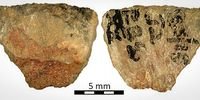
This evidence for the most complex technology known in hunter-gatherer behaviour is a ‘clear sign of advanced thinking in early humans’, the scientists believe. Scientists have discovered what they say are the oldest traces of arrow poison that had survived on 60,000-year-old arrowheads. The quartz arrowheads were excavated at the Umhlatuzana Rock Shelter in KwaZulu-Natal, about 30km from Durban, and the discovery suggests that hunter-gatherers then had a sophisticated understanding of toxic substances and were using them to bring down game.
The researchers from Sweden and the University of Johannesburg identified the millennia-old poison as having come from the gifbol plant (Boophone disticha), which, with its fan of long, green, strap-shaped leaves, has a deadly reputation. It is known to kill livestock and is still used by some hunter-gatherers to poison their arrows. Identifying the poison from microscopic traces proved not only challenging, but was also the culmination of a 20-year journey for one of the scientists.
Professor Marlize Lombard, a researcher at the Palaeo-Research Institute at the University of Johannesburg, first saw the Umhlatuzana Rock Shelter quartz arrowheads when she was completing her Phd. She noticed that some of them appeared to have some sort of residue on them. “I started use-trace analysis of the small quartz artefacts during my PhD.
Read Full Article on Daily Maverick
[paywall]
It revealed that they were probably used as arrow tips or barbs, and I could see preservation of adhesives under the microscope. But at the time, I couldn’t say it was poison, because I couldn’t verify it chemically,” she recalls. The findings of the study werepublished in the scientific journal Science Advances.
“Since then, I’ve been looking for a person and a laboratory to work with. And 20 years later I found an archaeochemist. And we decided to collaborate.” That archaeochemist was Professor Sven Isaksson from the Archaeological Research Laboratory at Stockholm University, an expert in the analysis of organic residues in archaeological materials.
More than 200 arrowheads have been excavated from the site, but the team selected those artefacts with signs of residue on them. “We extracted residues from 10 arrowheads, and we found the same molecules on five out of the 10. That’s extraordinary,” Lombard says.
[/paywall]
