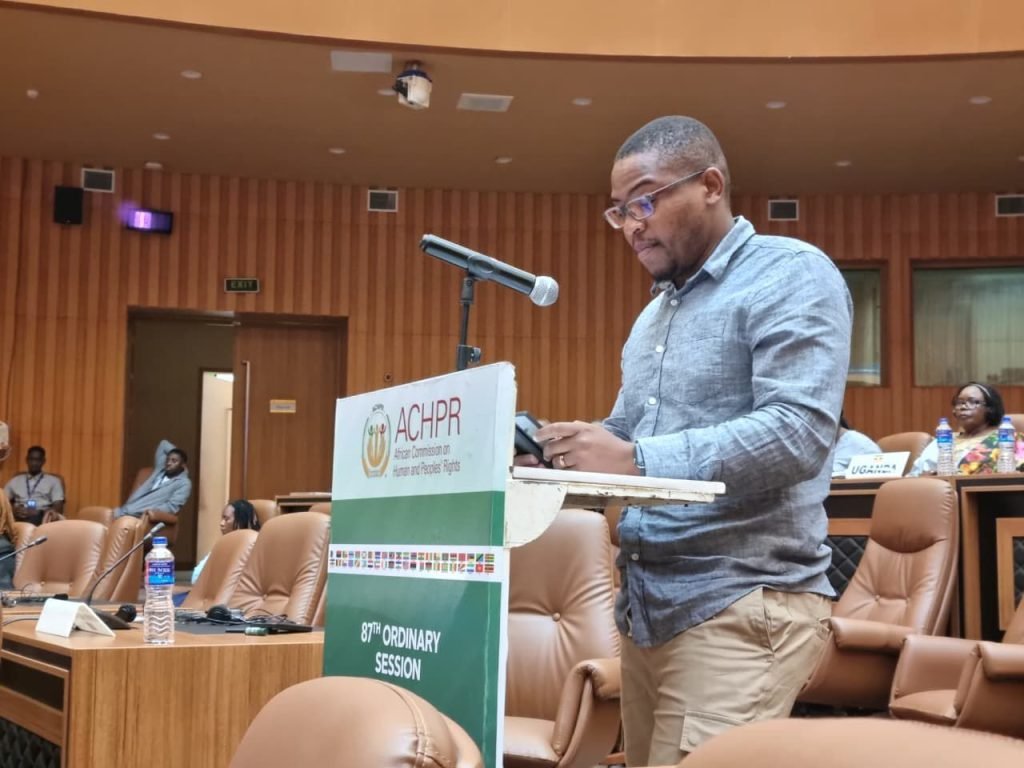
In a powerful presentation that brought the harsh realities of millions of African citizens to the floor of the African Commission on Human and Peoples’ Rights (ACHPR), Afrobarometer has declared that the continent is facing a structural crisis in water and sanitation that can no longer wait for incremental political promises.
Delivering the observer statement on behalf of the pan-African research network, Nyasha Mpani, Project Leader for the Data for Governance Alliance Project, provided a sobering, data-driven indictment of state accountability, revealing that more than half of the continent’s population experiences severe water scarcity.
The presentation coincides with the African Union’s declaration of 2026 as the “Year of Water Sustainability.” However, the empirical data gathered during Afrobarometer’s Round 10 surveys—encompassing 50,961 face-to-face interviews across 38 countries between 2024 and 2025—indicates that the rhetoric of sustainability is sharply disconnected from lived realities. According to the findings, a staggering 57% of Africans went without enough clean water at least once over the past year, with one in four experiencing this shortage many times or always. Citizens now rank water supply as their third-most-pressing problem, surpassed only by health and unemployment.

The briefing exposed deep structural discrimination embedded in public service delivery, showing that the burden of the water crisis falls disproportionately on rural and low-income populations. While 67% of urban residents have access to piped water systems, that figure plummets to just 31% in rural communities. In countries like Angola, Guinea, Nigeria, Sierra Leone, and Liberia, less than a quarter of surveyed communities have any piped water infrastructure at all. Furthermore, nearly half of all Africans (48%) must leave their domestic compounds simply to reach their main water source.
The sanitation crisis is even more pronounced, with only 25% of communities connected to a sewage system. In rural areas, sewage coverage drops to a negligible 8%, leaving approximately 8% of the entire continental population with no access to toilets or latrines. Among the poorest cohorts surveyed, 92% reported insufficient clean water access, illustrating that economic marginalization directly translates into a denial of fundamental human rights.
A longitudinal analysis of 28 countries tracked since 2014/2015 reveals a decade of systemic stagnation and decay. The proportion of citizens reporting water shortages has climbed from 46% to 56% over the last ten years. This infrastructure deficit is being severely exacerbated by climate change. One in three Africans (34%) has already been forced to reduce water consumption or alter their primary water sources due to shifting and erratic weather patterns—a figure that surges past 50% in nations like Tunisia and Guinea.
This multi-layered crisis has triggered a profound accountability deficit across the continent. On average, only 39% of citizens give their governments a passing grade on water and sanitation management. Discontent is near-universal in countries like Congo-Brazzaville and Nigeria, where 90% and 87% of the populations, respectively, rate state performance as poor. While isolated improvements were documented in Senegal, Tanzania, and Mali, public satisfaction has collapsed spectacularly in former regional leaders, dropping by 32 percentage points in Namibia and 25 points in South Africa over the last decade.

Confronted with these systemic failures, Afrobarometer urged the ACHPR to shift from developmental aspirations to strict legal frameworks. The pan-African body outlined four critical interventions for the Commission:
- Formally Affirm Justiciable Rights: Establish explicit accountability mechanisms for State Parties under Article 16 of the African Charter, allowing citizens legal recourse when the right to water is denied.
- Target Marginalized Demographics: Mandate that state reporting disaggregates data to ensure that aggregate national figures do not mask deep rural, gender, and economic inequalities.
- Integrate Climate Resilience: Recognize climate change not merely as an environmental issue, but as an active driver of human rights violations within the continental legal architecture.
- Enforce Continental Benchmarks: Embed specific water and sanitation metrics within the Commission’s Concluding Observations and Special Mechanisms to hold State Parties accountable to Agenda 2063 and the UN Sustainable Development Goals (SDGs).
In concluding the submission, the presentation acknowledged international financial interventions, such as the World Bank’s recent $1.58 billion commitment to water access in Eastern and Southern Africa, but cautioned that financing alone is insufficient without institutional transparency. The core message remains clear: political declarations must be weighed against the actual lived experiences of the population. Grounded in its founding principle that good governance must reflect the authentic opinions of ordinary people, Afrobarometer reminded the continent’s primary human rights organ that African citizens are actively monitoring their governments, demanding immediate action, and waiting for their fundamental rights to be realized.
Afrobarometer presentation at the 83rd Ordinary Session of the ACHPR
Read Full Article on Africa Hotspot
All Zim News – Bringing you the latest news and updates.
