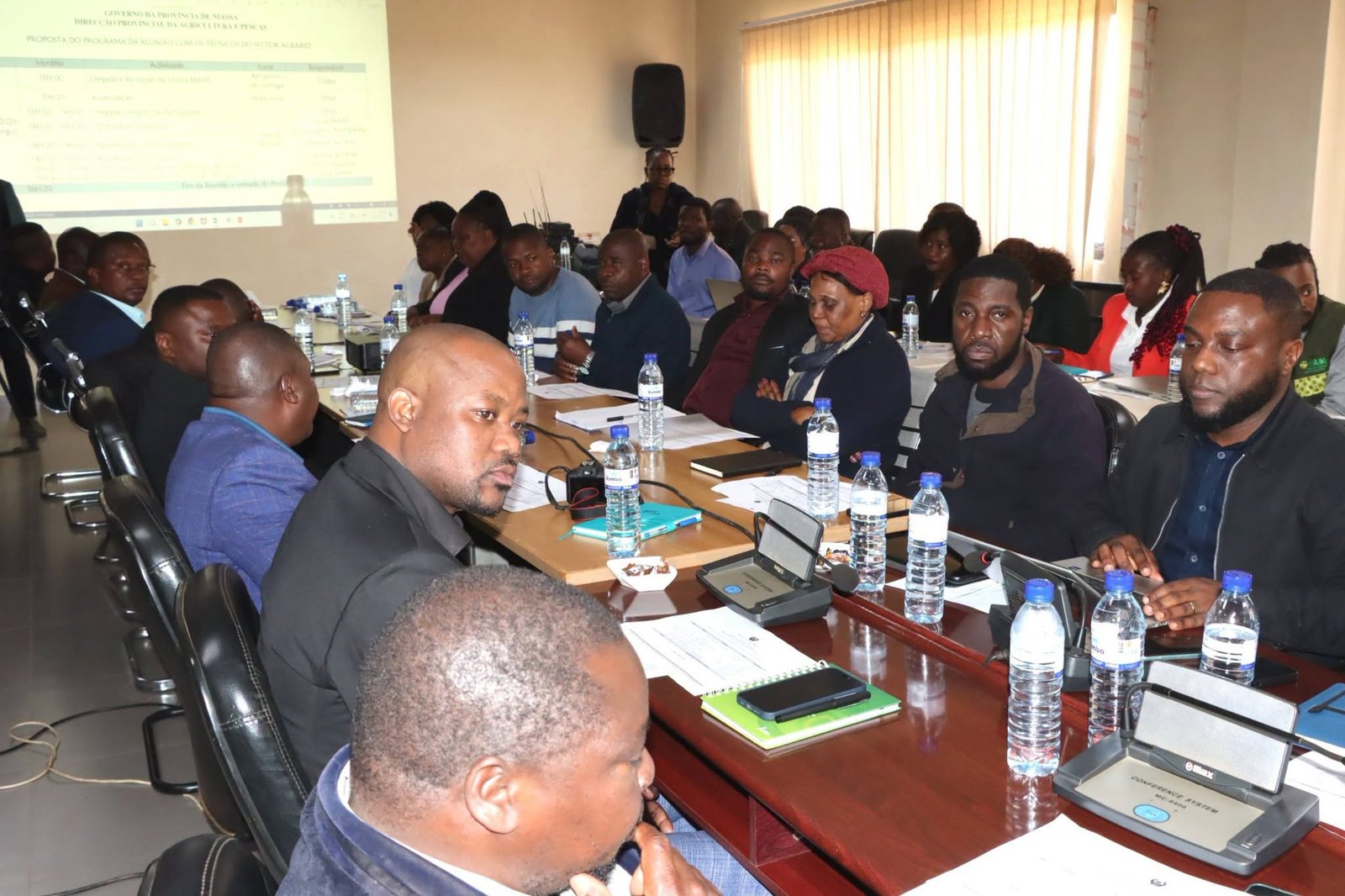
«Niassa being the agricultural capital means it is the place where resources must be prioritised to enable large-scale production. But this will only be possible if we are all committed to achieving this goal,» said Roberto Albino, quoted on Monday in a statement from the Ministry of Agriculture, Environment and Fisheries. According to the minister, the government’s plan envisages a special focus on the production of staple foods, including cereals, pulses, beans and soya, as well as on the development of poultry farming, fisheries and traditional and emerging cash crops, such as cashew and macadamia.
Photo: Ministério da Agricultura, Ambiente e Pescas The action plan for agricultural development in the province, located in northern Mozambique, is structured to cover the next three agricultural seasons and is expected to involve various stakeholders in the sector, in order to mobilise technical knowledge, experience and professional expertise to achieve the established targets. Flávia Langa, Niassa’s provincial director of Agriculture and Fisheries, also quoted in the document, highlighted the province’s agricultural potential, noting that the province has around 10 million hectares of arable land. Of this total, she explained, around 2.75 million hectares are available for agricultural production and a further 222,500 hectares are covered by Land Use and Exploitation Rights (DUAT), and are open to investment partnerships.
According to Langa, Niassa offers favourable conditions for the production of various crops, including maize, cotton, tobacco, soya, groundnuts, sweet potatoes and mapira. She also highlighted the province’s aquaculture potential, estimated at around 58,000 hectares of land suitable for aquaculture, which benefits from favourable natural conditions, notably shallow water tables, permanent springs, long periods of rainfall and soils suitable for the activity. Langa further emphasised that Niassa possesses significant water resources, including the respective tributaries, factors which bolster the growth prospects of the fisheries sector.
Read Full Article on Club of Mozambique
[paywall]
Among the main fish species found in the province are the usipa (sardine), chambo, malobolo, ncheni, campango, catfish and various ornamental species. According to figures presented by the provincial director, Niassa’s fisheries production potential is estimated at around 34,700 tonnes of fish per year.
[/paywall]
All Zim News – Bringing you the latest news and updates.
