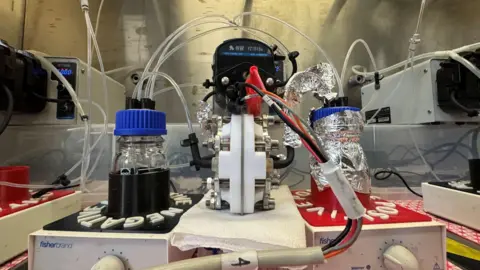
A 3D-printed battery developed at Queen’s University Belfast could “make a genuine impact” on the road to net zero, say the researchers behind it. Flow batteries are seen as key to scaling up renewable energy, allowing it to be stored for when the wind is not blowing and the sun is not shining. But they are expensive and typically use a metallic element – vanadium – that is only produced in a few places round the world.
Now, scientists at QUB have developed one based on iron, which is much easier to source, and have sent it around the world to help standardise research. It is hoped it will accelerate the renewable energy revolution, making research more reliable and its findings more scalable. Two clear jars with blue plastic lids are sitting on two separate platforms, one marked positive, the other negative/ The jars have tubes coming out of the top of them which are attached to a central piece of machinery that is also attached to black and red electrical wires. Post-doctoral researcher Dr Hugh O’Connor began tinkering with the design of flow batteries when he needed one for his PhD – and realised it would cost £2,000-£3,000.
Read Full Article on Club of Mozambique
All Zim News – Bringing you the latest news and updates.
