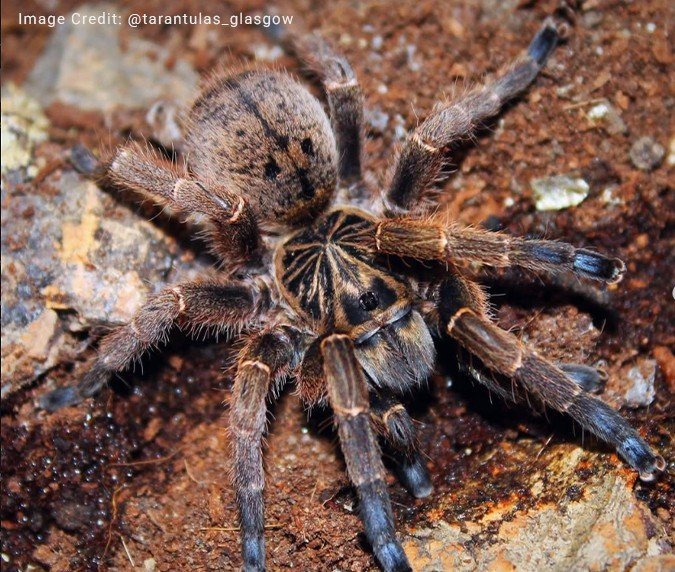
When people think about South Africa’sillegal wildlife trade, they usually picture rhinos, elephants or pangolins. Few would imagine that a small spider, hidden for most of its life beneath a trapdoor burrow, could also find itself in the crosshairs of collectors. Yet theblue-footed baboon spider, a little-known species found only in South Africa, is increasingly appearing in the international exotic pet trade.
Rarely seen and confined to a limited range, the spider’s striking blue legs and unusual burrow-building behaviour have made it desirable to collectors. ForSibongakonke Ngogodo, the wildlife in trade legal officer at theEndangered Wildlife Trust(EWT), its predicament highlights a broader conservation challenge: many vulnerable species receive little attention because they are small, obscure and poorly understood. Baboon spiders are ground-dwelling African tarantulas.
Ngogodo notes that South Africa has a rich diversity of the spiders — the South African National Biodiversity Institute (Sanbi) recorded eight genera and 44 species, many of them endemic. The blue-footed baboon spider can be recognised by the sky-blue colour on the upper surface of the final segments of its legs. Unlike many animals that move widely through the landscape, baboon spiders are generally sedentary.
Read Full Article on Mail & Guardian
[paywall]
They spend most of their lives in silk-lined burrows and rarely venture far from them. The behaviour makes them difficult to detect but it also leaves populations vulnerable when collectors target known sites, Ngogodo writes in the latest edition of the EWT’sConservation Mattersmagazine. Wildlife trafficking is often discussed through the lens of charismatic animals with tusks, horns, scales or feathers.
But smaller species such as spiders, scorpions, reptiles, amphibians and insects can also be targeted because they are rare, unusual or difficult to obtain, she says. The growing demand for exotic pets has created a market for species that many people would never associate with the wildlife trade. For the blue-footed baboon spider, collection is not the only concern.
Scientists know relatively little about its ecology and distribution, making it difficult to assess population trends or determine the extent of threats facing the species. The knowledge gaps matter because conservation authorities cannot effectively protect species they do not fully understand. The spider’s habitat specificity compounds the problem.
Quiet, cryptic and closely tied to particular environmental conditions, it can disappear from an area long before anyone realises there is a conservation concern. Sanbi says blue-footed baboon spiders appear in the international exotic pet trade with some regularity, although current levels of exploitation remain unknown.
[/paywall]
All Zim News – Bringing you the latest news and updates.
