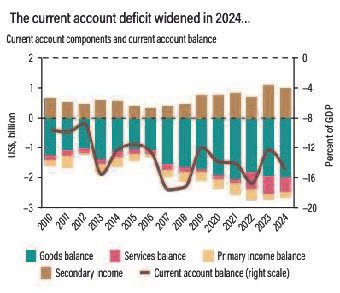
The African Development Bank (AfDB) has said Malawi’s current account deficit is projected to remain high amid ongoing foreign exchange shortages and exchange rate misalignments. The current account deficit, a measurement of a country’s trade where the value of goods and services imported exceed the value of goods exported, has traditionally been large on the back of soft export performance and elevated import demand, extending a deterioration that has persisted since 2019. Data contained in the AfDB Southern Africa Regional Overview show that Malawi’s current account deficit is projected to remain high at 16.9 percent of the gross domestic product (GDP) in 2026.
This is a decline from the previous year’s 17.9 percent and 18.5 percent of GDP projected in 2024. Regionally, Southern Africa’s current account deficit stood at 1.5 percent of GDP in 2024 and is projected to deteriorate to three percent in 2025 before easing slightly to 2.9 percent in 2026. In an interview on Tuesday, Mzuzu University economics lecturer Christopher Mbukwa observed that the large current account deficit triggers currency instability, high inflation and limited economic growth.
He said high current account deficit is an indication that Malawi is spending more foreign currency on imports than it is earning from exports, which is creating a forex shortage and making it difficult to import strategic commodities. Said Mbukwa: “This also weakens the Malawi kwacha, making imported goods expensive. “Another implication is that businesses fail to import inputs, which slows down production, which in turn affects commodity prices for consumers.” Bu s i n e s s Pa r t n e r s Internat i o na l count r y manager Bond Mtembezeka observed in an interview that as an economy, Malawi is yet to meaningfully drive the import substitution agenda forward.
[paywall]
“The widening current account will translate into thinner forex inflows as we are taking out through imports more than we are taking in through exports, pushing forex rates even on the parallel market up,” he said. World Bank data show that in 2025, exports were estimated at $950 million (about K1.6 trillion), unchanged from 2024, while imports grew by 12.2 percent to $3.7 billion (about K6.4 trillion), a pattern that is likely to keep the current account under pressure and further deepen the deficit. In its February 2026Malawi Economic Monitor, World Bank observed that with the parallel market demanding a premium of 140 percent over the official kwacha-dollar exchange rate and the mandatory surrender of export proceeds to the RBM for most exporters currently at 25 percent, government policy functions as an implicit tax on formal exporters who receive fewer kwacha for their exports than they would at market rates. The multilateral bank observed that allocating foreign exchange at overvalued official rates to select individuals, firms, industries and government entities grants the beneficiaries an implicit subsidy as they can obtain foreign currency for less than market value.
[/paywall]
All Zim News – Bringing you the latest news and updates.
