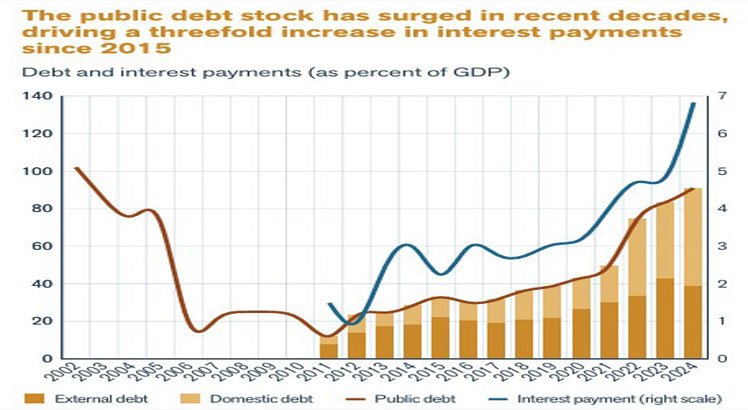
The International Monetary Fund (IMF) says Malawi’s fragile public finances are under renewed strain due to global aid cuts that expose deep structural flaws in its economic model. The global lender has since warned that the shock could either accelerate fiscal instability or compel long-overdue reforms. In its latest Regional Economic Outlook for Sub-Saharan Africa, the IMF indicated that bilateral aid to the region, including Malawi, fell by an estimated 16 to 28 percent in 2025.
The Bretton Woods institution has described the situation as “a shock like no other” driven largely by donor-side decisions rather than domestic conditions. The report further adds that the cuts are “larger, more synchronised across countries and predominantly donor-driven,” limiting alternative sources of support. The timing is particularly difficult for Malawi as its public debt has reached unsustainable levels above 90 percent of gross domestic product (GDP), with the public debt stock standing at K23.9 trillion as of December.
In an interview yesterday, Scotland-based Malawian economist Velli Nyirongo said the aid shock is not simply another external disruption, but one that “exposes long-standing structural weaknesses” in economies such as Malawi that have historically relied on external support to finance both development and recurrent spending. “At the same time, the government’s limited fiscal space reduces its capacity to absorb or offset this change without difficult trade-offs,” he said. Nyirongo said in the short-term, the risks are skewed towards deeper fiscal strain.
[paywall]
In a separate interview, Mzuzu University economics lecturer Christopher Mbukwa said the shock is already worsening fiscal pressures, citing constrained spending space, a growing deficit and rising debt. “In the immediate period, the current aid shock is contributing to the worsening of fiscal challenges. Many key sectors remain underfunded,” he said.
Mbukwa added that the government may be forced to either increase borrowing to fill the gap or cut expenditure in key sectors both of which carry risks for growth. University of Malawi economics lecturer Edward Leman said the shock could “catalyse overdue reform”, particularly in domestic revenue mobilisation, expenditure efficiency and export-led growth. He noted that the situation could push authorities to strengthen institutions such as Malawi Revenue Authority and support small and medium enterprises to improve productivity and tap into domestic and international markets.
[/paywall]
All Zim News – Bringing you the latest news and updates.
