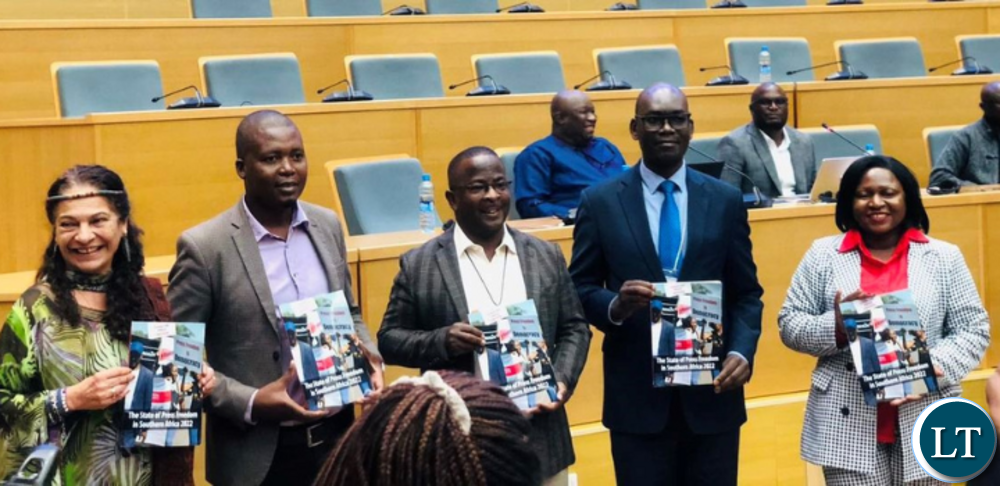
Media Institute of Southern Africa (MISA) says the state of press freedom in Southern Africa remains under threat as journalists continue to operate under difficult and sometimes dangerous conditions. MISA Executive Director, Tabani Moyo revealed this during the launch of the 6th edition of the 2026 Southern Africa Press Freedom Report at the ongoing 2026 World Press Freedom Conference in Lusaka. Mr Moyo said the report documents the challenges faced by journalists across Southern African countries.
He highlighted findings in the latest report that revealed growing concerns around technology-facilitated gender-based violence, harassment and sexual harassment targeting journalists. He cited findings from Tanzania showing that more than 77 percent of journalists surveyed had experienced sexual harassment, while in Zimbabwe over 63 percent of women surveyed reported experiencing online gender-based violence. Mr Moyo warned that the rise in online abuse is contributing to growing mental health challenges among journalists.
“The reports, compiled over the past six years, are aimed at strengthening evidence-based advocacy for media freedom and journalist safety in the region,” Mr Moyo said. Mr Moyo also noted some positive developments in the region, including Zambia’s self-regulation framework for the media and progress in the operationalisation of the Access to Information laws.He also cited reforms in Eswatini, where new licences for community broadcasters have been issued, as well as Zimbabwe’s initiatives in artificial intelligence policy and media and information literacy.Despite these gains, Mr Moyo expressed concern over what he described as “claw backs” through restrictive cyber and digital laws, criminalisation of investigative journalism, weakening whistleblower protection mechanisms and shrinking civic space.He further noted that media viability remains a major challenge as news organisations navigate digital transformation, artificial intelligence and economic pressures.Mr Moyo said media freedom in Southern Africa now exists within a rapidly changing environment where progress and setbacks continue to occur simultaneously. Mr Moyo also noted some positive developments in the region, including Zambia’s self-regulation framework for the media and progress in the operationalisation of the Access to Information laws.
Read Full Article on Lusaka Times
[paywall]
He also cited reforms in Eswatini, where new licences for community broadcasters have been issued, as well as Zimbabwe’s initiatives in artificial intelligence policy and media and information literacy.Despite these gains, Mr Moyo expressed concern over what he described as “claw backs” through restrictive cyber and digital laws, criminalisation of investigative journalism, weakening whistleblower protection mechanisms and shrinking civic space.He further noted that media viability remains a major challenge as news organisations navigate digital transformation, artificial intelligence and economic pressures.Mr Moyo said media freedom in Southern Africa now exists within a rapidly changing environment where progress and setbacks continue to occur simultaneously. He also cited reforms in Eswatini, where new licences for community broadcasters have been issued, as well as Zimbabwe’s initiatives in artificial intelligence policy and media and information literacy. Despite these gains, Mr Moyo expressed concern over what he described as “claw backs” through restrictive cyber and digital laws, criminalisation of investigative journalism, weakening whistleblower protection mechanisms and shrinking civic space.He further noted that media viability remains a major challenge as news organisations navigate digital transformation, artificial intelligence and economic pressures.Mr Moyo said media freedom in Southern Africa now exists within a rapidly changing environment where progress and setbacks continue to occur simultaneously.
Despite these gains, Mr Moyo expressed concern over what he described as “claw backs” through restrictive cyber and digital laws, criminalisation of investigative journalism, weakening whistleblower protection mechanisms and shrinking civic space. He further noted that media viability remains a major challenge as news organisations navigate digital transformation, artificial intelligence and economic pressures.Mr Moyo said media freedom in Southern Africa now exists within a rapidly changing environment where progress and setbacks continue to occur simultaneously.
[/paywall]
All Zim News – Bringing you the latest news and updates.
