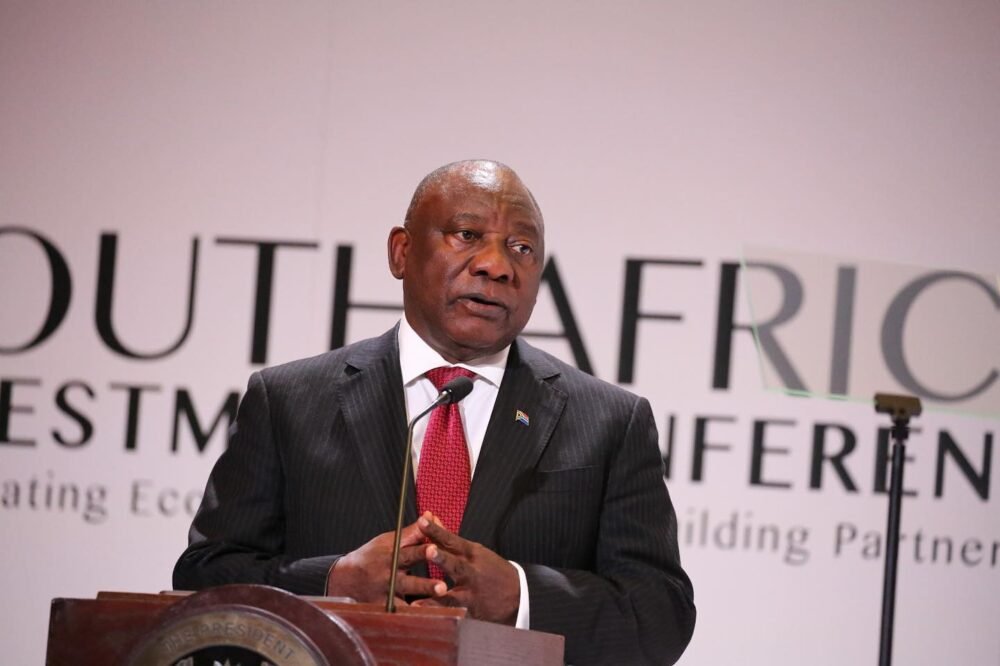
South Africa is stepping confidently onto the global investment stage. Over the past few years, the country has not only set ambitious investment targets but has also exceeded them, securing more than R1.5 trillion in commitments across sectors ranging from energy and telecommunications to advanced manufacturing and infrastructure. The 2026 South Africa Investment Conference alone confirmed nearly R890 billion in new projects, poised to create more than 230 000 permanent jobs across all nine provinces.
Inspired by this success, the 2026 Gauteng Investment Conference (GIC), held on 9 April in Johannesburg, surpassed its R200 billion target by securing between R205.6 billion and R206 billion in new investment pledges. This brings the two-year cumulative total to R518 billion, advancing the province’s R800 billion ambition over three years. These figures tell the story of a nation that is steadily moving from promise to action.
Detractors who persistently dismissed President Cyril Ramaphosa’s investment conferences as little more than empty and expensive talk shops, with no real prospect of delivering meaningful economic impact, are now not only eating humble pie but also scrambling for a place to hide. In an era when cynicism too often dominates public discourse and doubt easily overshadows progress, the facts speak volumes. South Africa is attracting capital, rebuilding confidence and laying the foundations for a new era of industrialisation, energy security and inclusive growth.
Read Full Article on Mail & Guardian
[paywall]
At the centre of this progress is the South Africa Investment Conference process, which has become a strategic platform for economic transformation and a powerful signal to the world that South Africa remains a strategic investment destination, rich in opportunities and determined to succeed on the global stage. More importantly, it proves that when leadership is focused, institutions are aligned and policy direction is clear, capital responds. In the green economy, the energy and resources cluster alone accounts for 19 projects worth R55.6 billion across seven provinces, backed by investors from seven countries.
In information and communications technology (ICT), the digital economy and financial services, 41 projects worth R23.6 billion will reach every province, deepening digital inclusion and strengthening the foundations of a modern economy. Tourism, property and infrastructure contribute R2.43 billion across KwaZulu-Natal and Mpumalanga, while agro-processing, food and agriculture add R7.3 billion. Automotive and advanced manufacturing account for R12.5 billion, with transport, logistics, aerospace and defence contributing a further R11.6 billion.
This diversification is crucial because the investment drive is not dependent on one sector, one commodity or one geography. Instead, it reflects a more balanced and resilient growth model capable of broadening participation across provinces and deepening value chains across the economy. The strength of this approach is even clearer in the landmark commitments already on the table.
Sasol’s R60 billion investment in upgrading plants in Mpumalanga and the Free State is a major vote of confidence in South Africa’s industrial base and energy-linked manufacturing capacity. It reinforces the country’s role as a key industrial hub while supporting the transition to more efficient and future-ready operations. Valterra Platinum’s major commitment in Limpopo, including new mining shafts, a smelter and expanded operations, strengthens South Africa’s position in the critical minerals value chain just as the global energy transition drives demand for strategic resources.
Cornubia 957’s R25 billion investment and MTN’s R21.8 billion commitment further underscore the importance of property development, connectivity and digital infrastructure as building blocks of the next phase of growth. The energy transition, in particular, is beginning to take visible and practical form. Mulilo’s R14.8 billion investment commitment in four renewable energy projects spanning the Free State, North West and Western Cape demonstrates that South Africa’s energy transition has moved well beyond rhetoric.
It is now being actively financed, built and accelerated. Actom’s R250 million investment in grid expansion equipment in Gauteng and the Western Cape reinforces that generation alone is not enough. Transmission and distribution are equally essential.
[/paywall]
All Zim News – Bringing you the latest news and updates.
