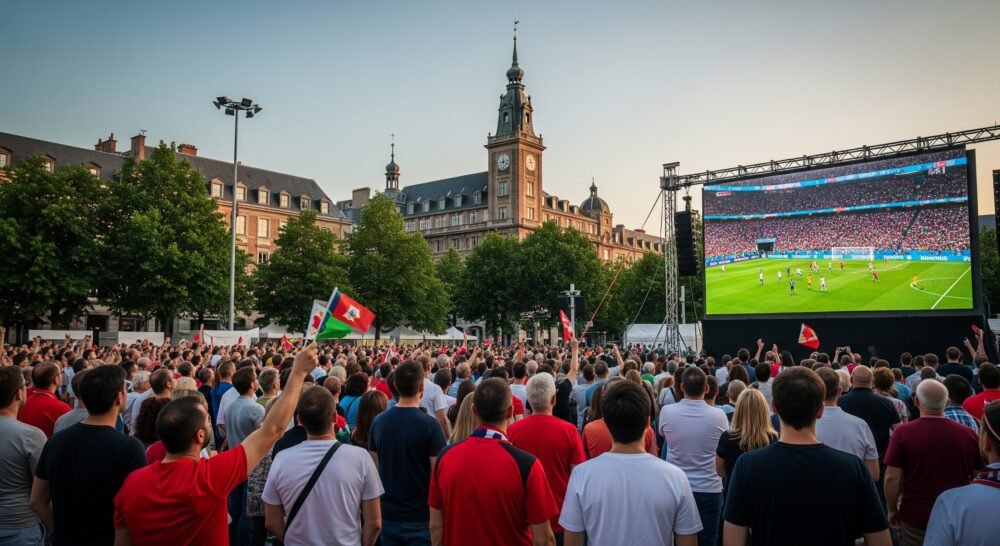
Public life rarely moves in straight lines. A city can feel calm for weeks, then one match, one march, one headline changes the mood in a single evening. That is one reason sport matters beyond trophies and league tables.
It gives people a common language for pressure, loyalty, disappointment, and release. Few cultural forces can bring strangers into the same rhythm as quickly as a major game, a derby, or a national team run. That does not make sport innocent.
It can soften tensions or sharpen them. It can create belonging or expose who feels left out. But that instability is exactly why sport remains such a powerful lens on public life.
Read Full Article on Mail & Guardian
[paywall]
It does not sit outside society and comment from a safe distance. It absorbs the mood of the street, then throws it back with floodlights on. The old idea that sport belongs in a separate section now feels quaint.
Clubs are brands, stadiums are civic stages, and athletes carry political and cultural meaning whether they want to or not. A banner in the stands can become a headline before halftime. A player’s gesture can travel farther than a minister’s speech.
Even ordinary conversation borrows sports language because it helps people describe power in motion. That crossover happens for practical reasons too. Sport is one of the few mass experiences that still unfolds live, with millions watching the same uncertainty at the same time.
People do not just consume it. They rehearse their own beliefs inside it: who deserves support, what fairness looks like, how institutions behave under stress. Fans often describe loyalty as a private matter.
In reality, it is public theater. Scarves, chants, watch parties, commuter debates, group chats, neighborhood screens: these rituals turn individual feeling into something visible. A title win becomes attached to a street or a season of someone’s life.
A collapse becomes a collective scar. That is culture in its raw form. Three things make sports rituals unusually powerful: In a time when public life often feels fragmented into algorithmic tribes, sport still creates moments when people argue inside a common frame.
The argument can be fierce, but the frame is shared. That alone gives sport unusual civic weight. Social change loves to pretend it was obvious from the start.
It almost never is. Large shifts in public feeling usually look confusing while they are happening. A team that seemed stable suddenly feels fragile.
A coach who looked untouchable begins to seem temporary. A city that treated sport as weekend entertainment wakes up and realizes the club badge has become part of its political vocabulary. That unpredictability is not a flaw in the system.
It is the system. Crowds are volatile. Institutions overreact.
Media narratives speed up and then break apart. Emotion enters first; analysis catches up later. Sport teaches that lesson better than most fields because it compresses it into a match, a series, or a final over.
The same uncertainty that shapes public moods also explains why sports betting keeps attracting fans who live inside the details. They study injuries, line movement, scheduling fatigue, crowd energy, and coaching habits because prediction feels meaningful when the ground is unstable. That is whereMelBet Zambiafits naturally into the wider sports conversation.
A platform with live markets, broad event coverage, and quick access to statistics turns uncertainty into a form of active reading rather than passive watching. The wager is only part of the appeal; the deeper pull is testing your interpretation of a public event before the event settles into history. Modern sports coverage no longer waits for the final whistle.
The build-up is content. The rumor is content. A tactical thread, a clip, a quote, a shaky crowd video from the concourse: each can influence the emotional weather around a club or a match.
That feedback loop matters because public life now works the same way. Attention moves fast, and interpretation becomes part of the event itself. This is why sports influence feels larger than the scoreboard.
Media systems reward emotion, tension, and narrative reversal. Sport provides them in concentrated form. Once that content leaves the stadium, it blends with conversations about identity, class, money, policing, nationalism, celebrity, and local pride.
[/paywall]
All Zim News – Bringing you the latest news and updates.
