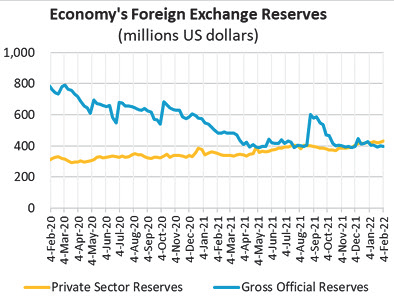
Malawi’s foreign exchange reserves have risen to $608.9 million (about K1.1 trillion), equivalent to 2.4 months of import cover at the end of February this year, signalling modest improvement in external liquidity, but still falling short of adequacy thresholds. The increase, up from $511.8 million or 2.0 months of import cover in December 2025 and $530.9 million (about K928 billion) or 2.1 months a year earlier, reflects gains in both gross official and private-sector reserves. However, analysts say the recovery remains fragile, with reserve levels still below the widely accepted benchmark of at least three months of import cover for import-dependent economies.
Scotland-based Malawian economist Velli Nyirongo said in an interview on Wednesday that the improvement should be viewed cautiously. “The recent increase is a cautiously positive development, but it does not yet signal a sustained improvement in the country’s external position,” he said. Nyirongo noted that while the rise may reflect stronger inflows such as donor support, export earnings or tighter import management, it is likely driven by short-term or cyclical factors rather than structural changes.
“In the absence of consistent growth in diversified export earnings, the improvement should be viewed as a short-term recovery rather than firm stabilisation,” he said. The structural imbalance in Malawi’s external sector risk getting out of hand. Data shows the country spent about $1.02 billion (about K1.7 trillion) on fuel and fertiliser imports in 2025 alone equivalent to roughly 115 percent of total export earnings of $886.3 million (about K1.5 trillion) during the same period.
[paywall]
This means that Malawi is effectively spending more on just two critical imports than it earns from all exports combined, reinforcing persistent pressure on foreign exchange reserves. Nyirongo said sustaining reserve growth will be difficult under these conditions. “Malawi’s export base remains narrow and highly vulnerable to external shocks while the economy continues to depend heavily on imports,” he said, adding that external debt servicing obligations could further strain reserves, particularly if inflows weaken or global financial conditions tighten.
The weak reserve buffer limits the Reserve Bank of Malawi’s ability to stabilise the exchange rate and manage imported inflation, leaving the economy exposed to external shocks. Economics Association of Malawi president Bertha Bangara-Chikadza, in an interview on Wednesday, argued that building a more resilient reserve position will require structural reforms beyond short-term inflows. “There is a need to work on reforms, decisive fiscal consolidation, transparent foreign exchange currency management, export-led growth policies, and accelerated debt restructuring,” she said.
[/paywall]
All Zim News – Bringing you the latest news and updates.
