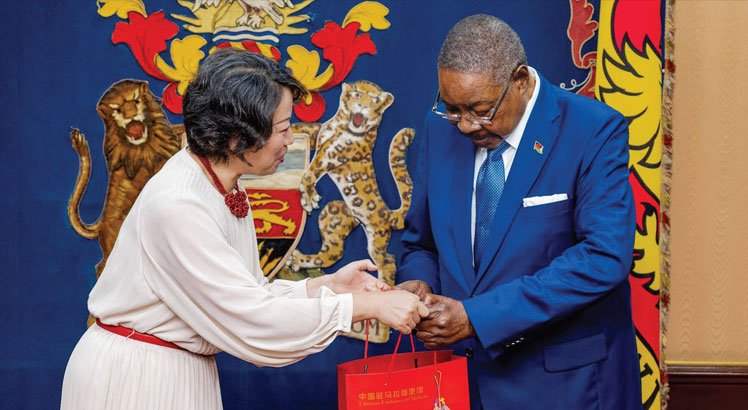
President Peter Mutharika has urged China to consider increasing access to its market for more Malawian products under zero-tariff arrangements. The President, speaking during a meeting with Chinese Ambassador Lu Xu at Kamuzu Palace in Lilongwe yesterday, urged Beijing to expand access for Malawian exports as part of efforts to drive economic recovery, job creation and export growth. According to a statement from the State House Press Office made available to The Nation, the President further called for deeper cooperation in mining, pushing for a shift towards value addition through the export of processed minerals rather than raw commodities alongside increased Chinese investment in energy, irrigation and industrial production.
Mutharika’s fresh lobby comes against a background of recent progress in bilateral trade relations between the two countries, which saw China granting zero-tariff treatment to all Malawian exports from December 2024. However, underlying trade patterns point to a structural imbalance. For example, recent data from the Observatory of Economic Complexity show that Malawi exported just $659 000 (about K1.15 billion) worth of goods to China in December 2025 compared to imports valued at $19.2 million (K33 billion), resulting in a trade deficit of $18.6 million (about K32.5 billion).
Malawi’s exports to China remain narrow and largely concentrated in low-value commodities such as raw lead, tea and aluminium, while imports are dominated by high-value manufactured and capital goods, including delivery trucks, tyres and iron products. The imbalance reflects a broader economic challenge: Malawi earns limited foreign exchange from exports while spending heavily on imports, reinforcing pressure on the kwacha and constraining economic stability. On his part, according to State House Press Office, Xu said discussions with Mutharika focused on strengthening practical cooperation across key sectors.
[paywall]
“We have discussed bilateral relations between China and Malawi. We have exchanged views on how best we can strengthen pragmatic cooperation in various sectors,” the statement quotes her as having said. China’s investment in mining and trade are meant to address the imbalances noted, but a local agricultural economist said yesterday Malawi’s weak export performance is rooted in deeper production constraints.
In an interview, Lilongwe University of Agriculture and Natural Resources Centre for Agricultural Research and Development director Innocent Pangapanga-Phiri said Malawi has historically struggled to meet export demand due to low productivity and insufficient volumes. Since establishing diplomatic relations in 2007, Malawi has received about $1.5 billion in Chinese financing, largely for infrastructure projects such as the Malawi University of Science and Technology in Thyolo, Parliament Building and Bingu National Stadium, Bingu International Convention Centre in Lilongwe.
[/paywall]
All Zim News – Bringing you the latest news and updates.
