What does it mean to remember a place you can no longer physically inhabit? And what does it mean to map a journey that was never meant to be purely geographical in the first place? For Cape Town artist Manyaku Mashilo, the questions are less theoretical than lived.
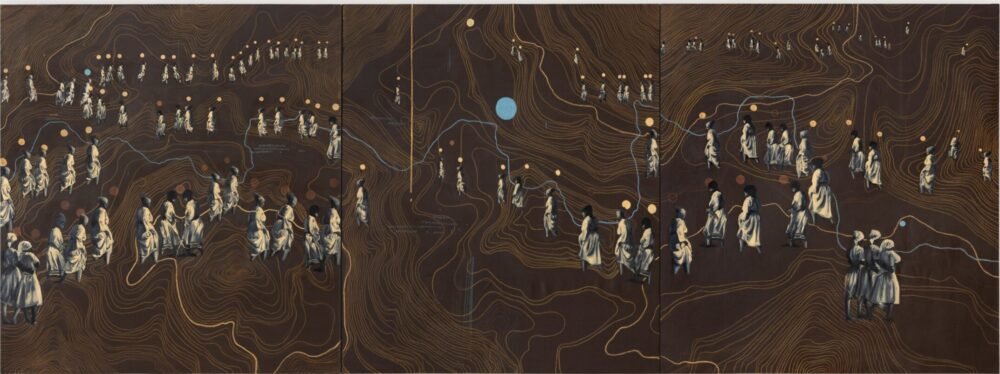
Across her layered mixed-media paintings, drawings and collages, figures move, sometimes in procession, sometimes in quiet drift, through expansive, abstract terrains that feel at once terrestrial and celestial. Beyond travelling, they’re searching, returning, remembering. Born in Limpopo in 1991, Mashilo has built a distinctive visual language rooted in spiritual identity, ancestry, community and belonging.
Her work draws deeply from family archives, historical photography and community memory, yet the worlds she constructs feel speculative, even otherworldly. The result is a practice that sits in the fertile space between documentation and dreaming, between what was and what might be. Her recent body of work,Here I Saw My Ancestors First(2026), presented at the Investec Cape Town Art Fair, offers perhaps one of her most distilled meditations yet on lineage, womanhood and spiritual inheritance.
Read Full Article on Mail & Guardian
[paywall]
When Mashilo approached the fair, her instinct was not to overwhelm but to refine. “I chose to try and be very minimal,” she explains. The presentation ultimately comprised four or five large-scale works, a deliberate decision that speaks to how she understands narrative in painting.
“I personally believe that the narrative that I’m trying to tell, which is the story of my grandmother but also that kind of representation, should be experienced on a large scale,” she says. Scale, for Mashilo, is memory made spatial. The expansiveness of her canvases mirrors the physical and emotional landscapes of her upbringing in Limpopo: wide church grounds, open rural horizons, the felt immensity of childhood environments.
Within the works, two visual registers often coexist. The first is figurative: women and girls emerge from layered colour fields, their presence calm but insistent. The second is cartographic: delicate linework ripples across the surface like topographical markings, suggesting mountains, rivers and migratory routes.
“I always try to include all the different kinds of my practice,” she notes. “One is very figurative … and then there’s another aspect of my work which has to do with map-making and the mapping of these women migrating through these sort of liminal spaces.”
[/paywall]
All Zim News – Bringing you the latest news and updates.
