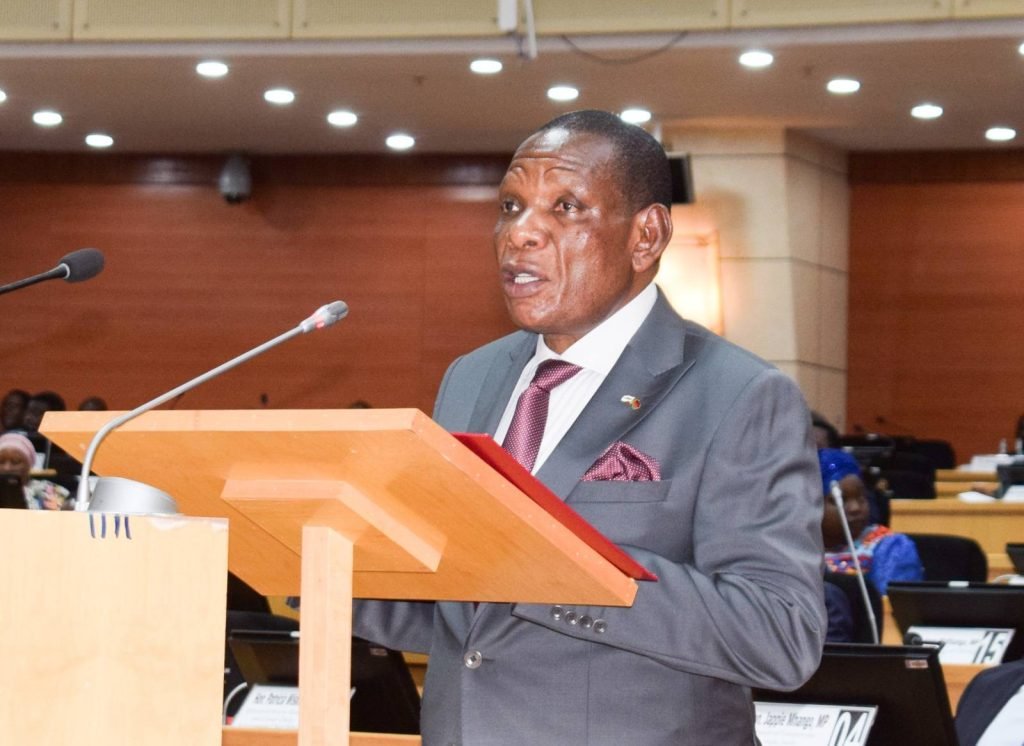

Minister of Finance, Economic Planning and Decentralisation Joseph Mwanamvekha yesterday unveiled a nearly K11 trillion budget anchored on deficit cuts, revenue expansion and a sharp surge in development spending to spur an economy weighed down by high inflation, mounting public debt and structural imbalances.
Mwanamvekha took more than two hours to deliver the 2026/2027 fiscal policy statement to a packed Chamber, maintaining a calm and composed tone throughout.
At moments, he appeared to enjoy the presentation, occasionally smiling as he outlined reform measures—perhaps relishing the opportunity to turn the economy around under the Arthur Peter Mutharika administration.
Even the usual partisan jeering and cheering from members of Parliament (MPs) appeared to wane midway through the marathon address, underscoring both the length and the technical density of the fiscal blueprint.
The K10.978 trillion package represents 34.8 percent of gross domestic product (GDP) and marks a 27.8 percent increase from the K8.589 trillion revised figure for 2025/26.
Macroeconomic assumptions anchor fiscal reset
The budget is built on a fiscalised GDP growth projection of 4.1 percent, an end-period inflation target of 15 percent, nominal GDP of K31.5 trillion and a policy rate of 18 percent.
These assumptions come against a backdrop of inflation that stood at 28.5 percent in 2025 and broad money growth of 44.9 percent—conditions that highlight the delicate balancing act between fiscal expansion and macroeconomic restr

aint.
Public debt remains elevated at K23.9 trillion, equivalent to 90.9 percent of GDP, with 65 percent of that stock held domestically—a deficit financing scenario that has created a vicious cycle of high-cost debt, crowded the private sector out of borrowing for investment and eaten into funds for critical social services such as health, education, water and sanitation.
As the debt stock expanded, so did repayments. Debt servicing is now approaching K2.5 trillion annually—rivaling or exceeding major sector allocations in several budget cycles.
Interest payments have followed a steep upward trajectory, rising from about 15 percent of total government expenditure (TGE) five years ago to 27 percent in the current financial year, reflecting higher domestic borrowing and refinancing pressures.
By contrast, allocations to the health sector have remained relatively flat as a share of expenditure, averaging below 10 percent of TGE across the period.
Education has fared better, hovering between 15 and 17 percent of TGE, but its growth has been outpaced by debt servicing. The widening gap suggests that rising interest obligations are increasingly competing with core social spending for limited fiscal space while suppressing development spending that is crucial to stimulating broad-based economic growth. Mwanamvekha’s budget yesterday sought to recast this spending imbalance between capital and recurrent outlays.
Development expenditure expands sharply
Development expenditure in the new budget now accounts for 30.9 percent of total spending, up from 20.9 percent in the current financial year—a structural shift signalling stronger emphasis on capital investment.
All Zim News – Bringing you the latest news and updates.
