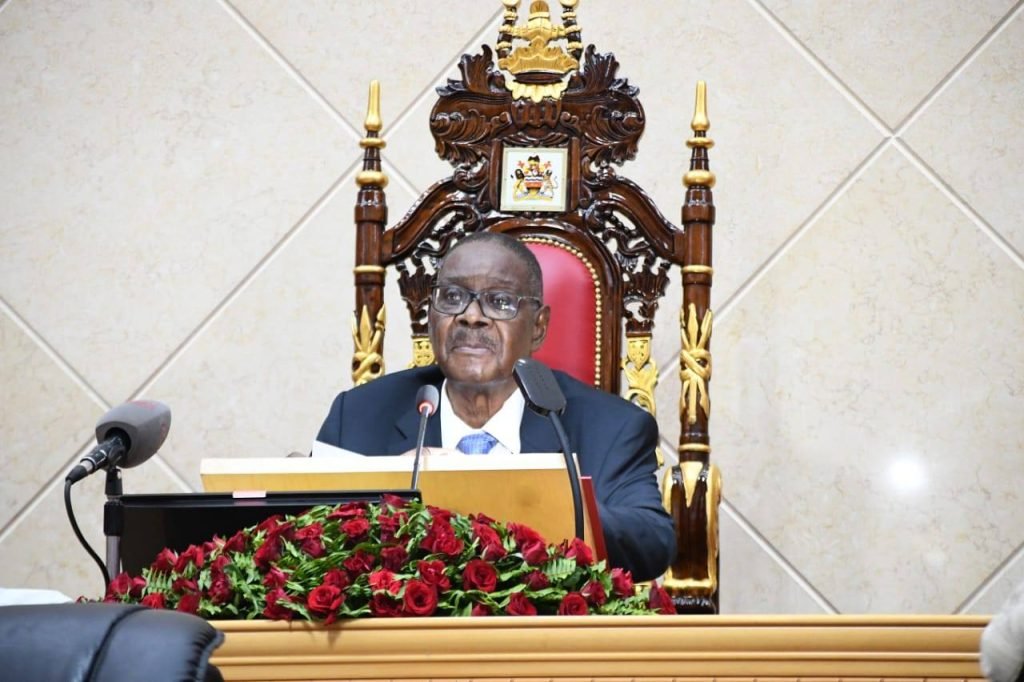
When President Peter Mutharika delivered the State of the Nation Address (Sona), he presented it as the start of a decisive turnaround — a shift from crisis management to structural reform. The budget presented weeks later by Minister of Finance, Economic Planning and Decentralisation Joseph Mwanamvekha reveals how much of that ambition can survive the hard limits of fiscal reality. With public debt now at K23.9 trillion and interest payments projected to consume K2.793 trillion this year, the 2026/27 National Budget confronts a stark question: can Malawi afford the economic transformation promised in February’s State of the Nation Address (Sona)?
In the Sona, the President projected growth rising from 2.7 percent to 3.8 percent in 2026 and further to 4.9 percent in 2027, while inflation was expected to decline from 28.7 percent to below 21 percent. The new budget does not contradict that trajectory. It projects a fiscal deficit narrowing from 11.9 percent to nine percent of gross domestic product.
Yet at K23.9 trillion, the public debt is equivalent to 90.9 percent of GDP while interest payments alone will consume K2.793 trillion this year. With nearly 79 percent of domestic revenue absorbed by statutory obligations, including wages and debt servicing, the fiscal space for accelerated transformation is constrained from the outset. But in industry captains and analysts see efforts to align the President’s vision to the national budget.
[paywall]
He added that with “prudent financial management and strategic investments, Malawi can overcome its economic challenges and achieve sustainable growth.” Scotland-based economist Velli Nyirongo is less convinced. He argues that reducing the deficit to nine percent “is not enough to stabilise debt at 90.9 percent of GDP” signaling how hard it will be to align presidential ambition with fiscal realities, especially given the high public debt overhang and attendant repayment costs. Nyirongo warned that without a meaningful primary surplus, debt dynamics will remain fragile and investor confidence constrained Infrastructure occupies a central role in bridging stabilisation and growth.
The budget allocates K664.4 billion to transport and ICT, roughly six percent of total expenditure of K10.978 trillion. Rehabilitation of sections of the M1 and M5 corridors, upgrades to the Nsipe–Liwonde–Zomba and Mangochi–Monkey Bay routes, and advancement of the Nacala Rail Corridor and Kanengo–Mchinji line aim to reduce logistics costs across agriculture, mining and tourism value chains. Port rehabilitation at Likoma and Chipoka and upgrades to Kamuzu International and Chileka airports reinforce trade and tourism connectivity.
Energy receives K219.8 billion to support grid stability and sector operations. Irrigation infrastructure, including K241.1 billion for the Shire Valley Transformation Project and K40 billion for the National Irrigation Development Programme, seeks to anchor agricultural productivity in the face of recurring climatic shocks. Taken together, these projects suggest the government views infrastructure as the transmission mechanism for recovery—a strategic stance.
[/paywall]
All Zim News – Bringing you the latest news and updates.
