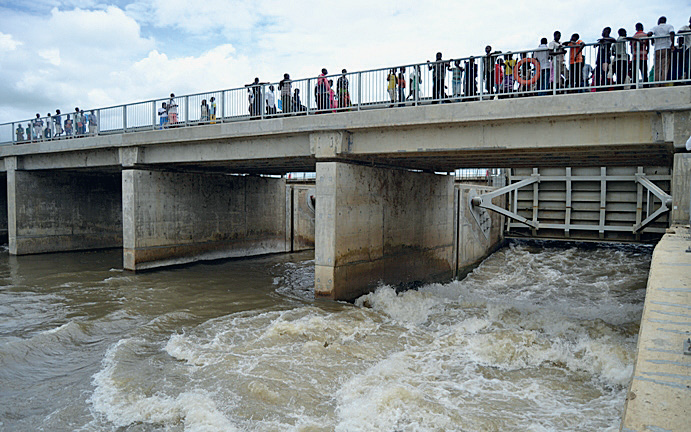
National Water Resources Authority (NWRA) has warned that a continued rise in Lake Malawi water levels poses a serious threat to farming and tourism along the lake as well as electricity generation downstream. In an internal communication on the situation at Kamuzu Barrage in Liwonde, Machinga, the authority said the lake level is rising rapidly and has already exceeded the levels for the past two years. The update indicated that mean lake level as of Friday, February 20 2026 stood at 475.69 metres above sea level (masl), representing nine centimetres and 19 centimetres higher than 2023/24 and 2024/25 rainfall season, respectively.
Thus, it warned that the reservoir level seems to be building up by a centimetre or so daily. While the lake’s current water levels are among the highest in recent years, the all-time record remains 477.22 masl reached in 1980 or 45 years ago. Still, the recent build-ups, including the 2024-25 water rise crisis, resulted in submerging of hospitality establishments, homes and farm lands, especially in the lakeshore districts of Mangochi and Salima as well as some parts of the Lower Shire in the Southern Region as the Shire River, whose source is Lake Malawi, also swelled and burst its banks along its lower sections while flowing through wide, flat flood plains.
In a written response on Wednesday, NWRA spokesperson Masozi Kasambala said due to continuous above normal rainfall as forecast by Department of Climate Change and Meteorological Services, huge water volumes were added into major rivers and ultimately into Lake Malawi. He said following that addition, all infrastructure and farms under the 477 masl contour line along Lake Malawi are likely to be affected, indicating that lake water levels will be higher than last hydrological year should the trend persist. Kasambala said the authority has increased discharge volumes at Kamuzu Barrage from 500 000 to between 900 000 and one million litres of water per second.
[paywall]
He said: “It is a delicate balance that we are undertaking to ensure that critical infrastructure downstream such as Nkula, Tedzani and Kapichira hydro-power stations are not negatively affected. “The discharge we are currently initiating falls within Shire River’s carrying capacity. .” Kasambala justified the balance, saying if they do not release more than the stated volumes through the 14 gates now opened at the barrage, flooding could ensue upstream the lake and all infrastructure will be submerged.
In an interview on Wednesday, Minister of Trade, Tourism and Industrialisation Simon Itaye said his ministry is aware of rising water levels in the lake and has been advising developers to take necessary steps to ensure that hospitality infrastructure is not affected. Electricity Generation Company public relations officer Mervin Mchenga was yet to respond to our questionnaire by press time yesterday on their level of preparedness should the rains persist.
[/paywall]
All Zim News – Bringing you the latest news and updates.
