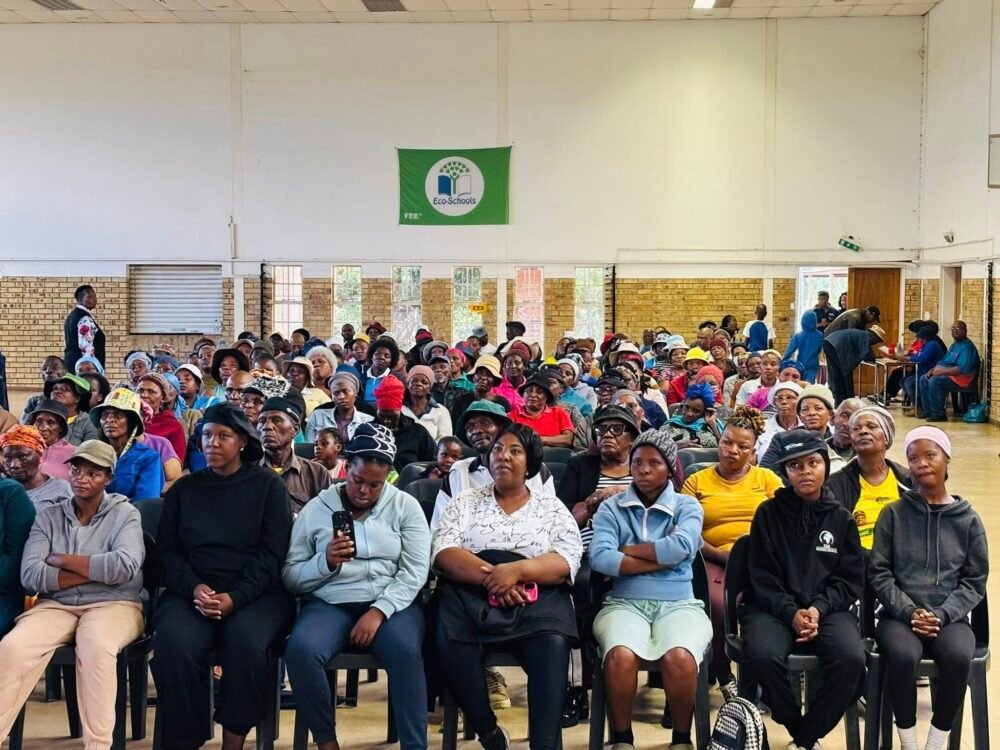
The collapse in the delivery of basic services in the local municipality of Matjhabeng in the Free State can best be described as non-discriminatory: no resident, rich or poor, is spared from the strong stench of sewage that permeates throughout, the roads riddled with potholes or the piles of uncollected rubbish. “Staying here is very difficult. We live in human faeces day and night.
We smell faeces all the time. Our health is at serious risk and we get sick from this sewage,” says Bongisa Sindesi, a resident in the large township of Thabong whose food-selling business is under serious threat. “Our businesses are crumbling.
People are not coming to buy from us because of the sewage issues. I stopped selling here and rented space elsewhere because customers complained about the smell.” In most South African municipalities, these problems usually only confront residents in mainly-black poor townships but not so in Matjhabeng. In suburban Doorn, medical doctor Marinda Op’thof still has sewage running past her house, years after first taking the municipality to court.
Read Full Article on Mail & Guardian
[paywall]
The municipality was ordered to pump sewage out of the manholes near the house twice a day but has never done so, she told theMail & Guardian. She was forced to return to the high court after the first order. “Nothing happened.
They just refused to do anything. They ignore everything because it’s not them personally who pay the legal costs, so they don’t even care,” a frustrated Op’thof said. “I even had to move my consulting rooms because all the roads leading to my house are full of potholes.
We have also had to fix the potholes ourselves,” Op’thof said. Businesses in the area were forced to build a wall around the manholes to direct the sewage to a nearby drain and prevent it from flowing into the streets, she added. According to residents, Teto Secondary School in Thabong has been repeatedly writing to the municipality, to no avail, after being forced to close its windows during classes because of the smell of sewage running right in front of the premises.
The municipality has failed to tackle the sewage problem because the treatment plants are not functioning, a senior insider told theM&G. “The trucks have to physically pump from the manholes and dump it. The problem now is that the sewage in the drains flows straight to the dam.
So we have a serious spillage at the dam. The water has been found to contain E. coli,” they said. In Thabong township, many children have sores on their hands and feet, which locals say are caused by contact with sewage.
[/paywall]
All Zim News – Bringing you the latest news and updates.
