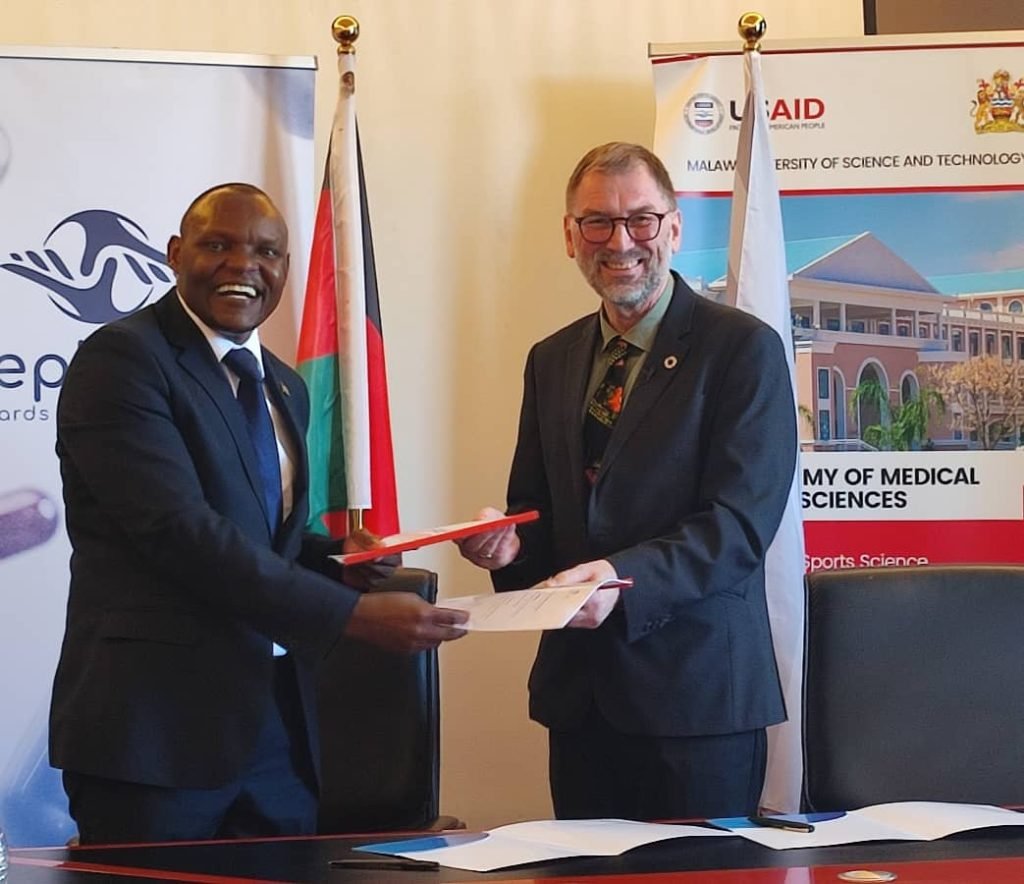
Malawi University of Science and Technology (Must) has announced plans to start manufacturing antiretroviral drugs (ARVs) and other medicines locally to reduce dependence on imported medicines. Yesterday, the university signed a memorandum of understanding (MoU) with Rephaiah Foundation to establish a modern pharmaceutical manufacturing plant by 2028. In an interview after the ceremony, Must Deputy Vice-Chancellor Professor Wilson Mandala said Malawi currently imports most of its essential medicines, including ARVs, thereby exerting pressure on the country’s foreign exchange reserves.
He said the pharmaceutical plant will initially focus on producing children’s medicines such as paracetamol before gradually scaling up to antibiotics and ultimately ARVs. Said Mandala: “The ultimate goal is to produce antibiotics locally and more importantly to produce ARVs locally. If you look at the amount of money Malawi spends procuring ARVs from the global market, it is huge.
Producing them locally will not only save foreign exchange but also create opportunities to export to neighbouring countries where demand is equally high.” He said his organisation has set aside about $65 million (approximately K113.8 billion) for the establishment of the pharmaceutical plant, describing the investment as a long-term commitment to Malawi’s health and industrial development. “We started discussing this project about ten years ago and conducted feasibility studies, which confirmed that pharmaceutical manufacturing in Malawi is viable. Malawi is also a peaceful and stable country, making it an ideal destination for such an investment,” said Gizurarson.
[paywall]
The ceremony was also attended by Ministry of Industrialisation, Business, Trade and Tourism Principal Secretary Bright Molande who commended Must for translating academic knowledge into practical industrial development. He said the initiative marks a turning point for Malawi’s higher education sector, urging universities to move beyond theory and actively contribute to economic transformation. “Wherever we go, universities are factories of ideas.
But the time has come for Malawi’s universities to turn those ideas into industries,” said Molande. Ministry of Health and Sanitation spokesperson Adrian Chikumbe in a separate interview yesterday said government imports over 80 percent of medical supplies which are used in public health facilities. However, he could not quantify how much government spends on importing medicine monthly or annually saying he needed more time to gather details.
[/paywall]
All Zim News – Bringing you the latest news and updates.
