The THK Gallery in Cape Town is currently presentingA Grammar of Belonging, an exhibition that brings together the perspectives of both emerging and established artists through photography, visual art and other creative forms. Artists such as Lulama Wolf and Trevor Stuurman, alongside a diverse group of contributors, weave together material archives — beads and earth — with visual and sonic traces, found photographs and shared traditions of making. Their works draw on generational fabrics and patterns, folklore, ideas of home and place and intimate portraits of connection.
Together, these layered expressions propose belonging not as a fixed state but as something shaped by intimacy, inheritance, relationships and the complex construction of identity. A Grammar of Belongingseeks to highlight that home and belonging transcend physical spaces and are carried in experiences shaped by places, people, art forms, cultures, history, movement and the solitude of personal devotion, approaching belonging as something fluid and unfolding rather than constant and unchanging. The home and specifically the concept of belonging, is seen as a space imbued with identity — a state which we return to and reminds us of ourselves.
It is physical and emotional and is a point of communion and generational exchange, informed by oral traditions and linguistic inheritance. It is kinship and care, where bread is broken and love is practiced and where play, interiority and joy persist. Featuring Kayoon Anderson, Driaan Claassen, Sahlah Davids, Joëlle Joubert, Tshepiso Moropa, Karla Nixon, Amy Rusch and Resego Sefora, Trevor and Lulama plan to highlight that home and belonging is carried within the body and identities are shaped by the imprints of those who have moved through and before us.
Read Full Article on Mail & Guardian
[paywall]
They ask us to consider what lingers and what lives on. “With this project, I am interested in exploring how we can reimagine belonging and home while simultaneously experiencing movement and art. These moving images represent the intersection of our past and present, exploring new ways of building identities and belonging,” Trevor explains.
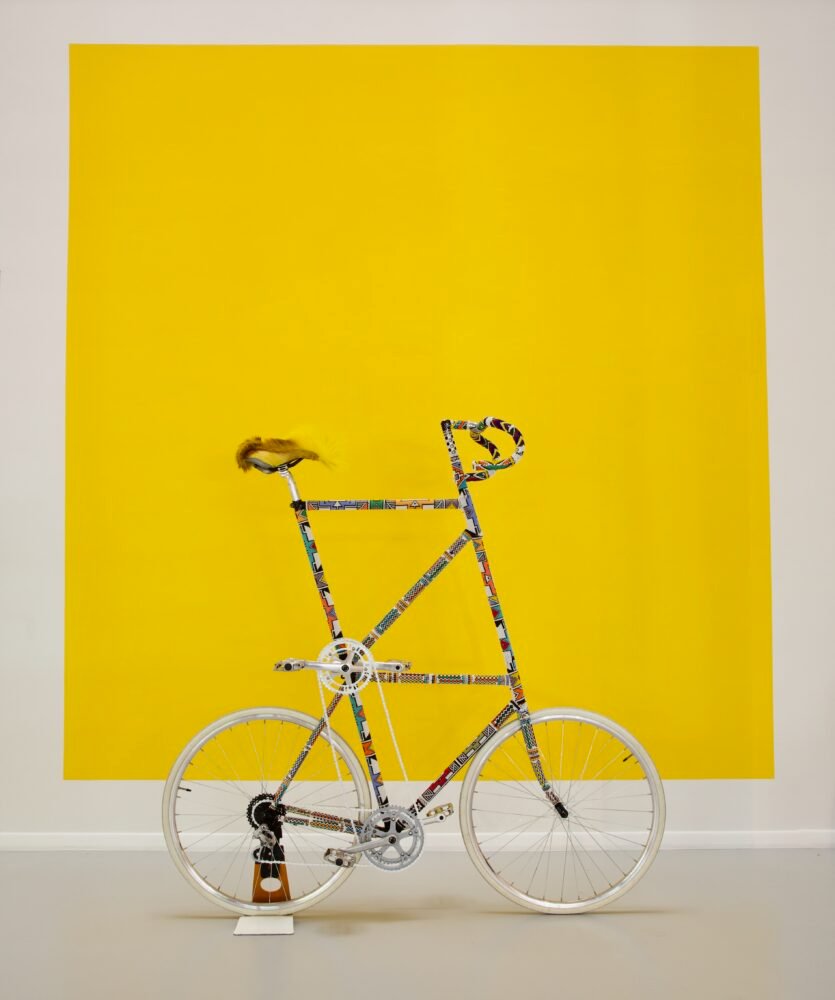
While showcasing his beaded bicycle, he further states that“A Grammar of Belonginglives in this beaded bicycle. It is an object where my personal memory and colonial history converge. The bicycle, the beads and my surname share Dutch origins, structures of movement, trade and naming that I inherited rather than chose.
This is not a conventional bicycle but two bicycles stacked vertically. The form becomes a ladder, an architecture of ascent. It echoes Donovan Livingston’s reminder that ‘our stories are the ladders that make it easy for us to touch the stars.’ Here, elevation is achieved not through speed but through accumulation, one story resting on another, one generation lifting the next.” While Lulama Wolf explores the pre-colonial African experience through a contemporary lens, her process involves smearing, scraping and employing deep pigment techniques inspired by vernacular architecture.
These techniques often incorporate patterns traditionally created by women to decorate traditional African homes. The patterns traditionally created by African women to decorate traditional African homes are a testament to the rich cultural heritage and artistic skills of the African people, decorations created by artists such as the world famous Esther Mahlangu. These patterns are not only decorative but also carry deep cultural meanings and stories of home and belonging.
Running until the 12th of March, 2026,A Grammar of Belonginginvites art lovers to reflect on the ways in which home is shaped by memory and movement and how it builds identity. This exhibition invites conversations and reflections about how history stays in the present. In bringing these conversations into an artistic space,A Grammar of Belongingforces us to see how all our struggles are interconnected.
[/paywall]
All Zim News – Bringing you the latest news and updates.
