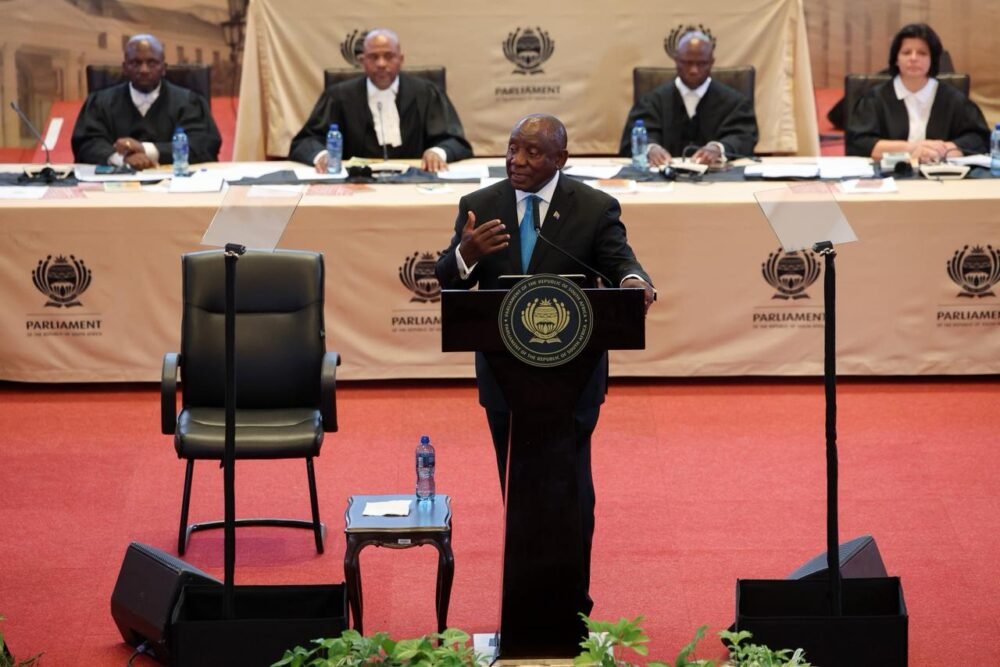
Every State of the Nation Address (SONA) in South Africa has become a platform not only for democratic accountability but also for predictable criticisms. Long before the President rises to speak, rebuttals have been drafted, headlines framed and conclusions drawn. This year was no different.
Yet intellectual honesty requires that criticism be weighed carefully. Which objections are substantive and grounded in fact? Which ones are ideological contestations masquerading as technical critique?
And which ones are simply recycled lines from prior years, deployed irrespective of what was actually said? A sober analysis reveals a far more nuanced picture than the political theatre suggests. This article critically assesses the key criticisms levelled at the State of the Nation Address.
Read Full Article on Mail & Guardian
[paywall]
One of the most common criticisms is that the President merely “repeated old promises” and offered “nothing new.” This argument rests on a fundamental misunderstanding of governance. Structural reform, infrastructure expansion, energy transition, industrial development and state capability are not once-off or one-year events. They are multi-year undertakings.
When the President reaffirmed commitments to stabilise energy supply, accelerate logistics reform, strengthen water security, deepen industrialisation and expand social protection, he was not recycling rhetoric. He was reinforcing continuity in a reform agenda that is, by design, cumulative. Countries that successfully reform do so through persistence, not policy hit-and-run.
To demand novelty for its own sake is to mistake continuity for repetition or stagnation. A reform agenda requires sustained execution, institutional consolidation and policy coherence over time. Another recurring complaint is that the Address lacked sufficient detail.
There are no timelines, no cost breakdowns, no technical blueprints, we are told. This critique ignores constitutional and procedural convention. The State of the Nation Address is a policy and strategic outline of priorities and direction.
It sets the macro frame. Detailed implementation plans, specific budget allocations and regulatory instruments are properly elaborated through cluster briefings, ministerial statements, briefings to portfolio committees and the Budget Speech. Expecting the President to deliver operational plans of all departments in a single address reflects a deep misunderstanding of both governance architecture and parliamentary practice.
He does not have the luxury of an entire day to speak, nor should he. Strategic clarity is the purpose of Sona. Operational detail is the responsibility of line ministries.
Critics know this. Yet the “lack of detail” argument persists, often less as a genuine concern but more as a convenient rhetorical device. Some detractors framed the announcements as part of electioneering, implying that delivery during an election cycle is inherently suspect.
This line of criticism is deeply flawed. The government does not suspend its constitutional duty because an election is approaching. Service delivery cannot be paused for the sake of political optics.
To suggest otherwise is to imply that citizens should endure stagnation and lack of services until all ballots have been counted. If infrastructure investments accelerate, if social protection expands, if reforms gain momentum, that is governance in action and a nation at work, not electioneering. It would be far more troubling if the government chose inaction to avoid accusations of political timing.
A noticeable portion of the criticism bore striking resemblance to responses delivered in previous years, sometimes word for word. This suggests that, for some political actors, critique is not contingent on content but predetermined by position.
[/paywall]
All Zim News – Bringing you the latest news and updates.
