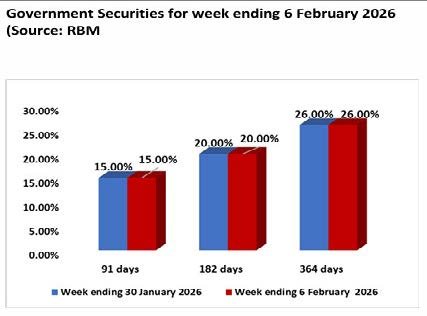
Treasury could be heading into a high-stakes domestic refinancing cycle this month with Treasury bills (T-bills) maturities exceeding K355 billion in February alone, according to Reserve Bank of Malawi (RBM) data. The maturities are clustered within four weeks of K48.7 billion, K81.4 billion, K126.8 billion and K98.1 billion, creating concentrated rollover pressure in a single month. At current yields, refinancing the instruments will come at elevated interest costs, locking in expensive domestic debt and tightening liquidity in an already strained financial system.
Analysts say the issue is not whether government can refinance the debt, but at what price and with what macroeconomic consequences. In a consolidation phase, the composition and cost of domestic borrowing are as important as the headline deficit. In an interview on Monday, Scotland-based Malawian economist Velli Nyirongo said that repeated heavy domestic debt rollovers risk entrenching a debt–inflation loop where deficits financed at high yields feed inflation expectations, keep interest rates elevated and weaken growth.
He said that while refinancing itself is routine, its broader implications depend on fiscal credibility and sequencing. “Without a parallel growth and governance agenda, high domestic borrowing can crowd out private investment, slow credit expansion and deepen structural weaknesses,” said Nyirongo. Speaking during the pre-budget consultation meeting in Lilongwe, Minister of Finance, Economic Planning and Decentralisation Joseph Mwanamvekha stressed the government is commitment to reducing reliance on the domestic market to rein in rising debt levels.
[paywall]
“We will continue to implement measures aimed at reducing domestic borrowing and restoring debt sustainability,” he said, stressing that fiscal consolidation remains central to macroeconomic stability. However, analysts warn that consolidation must go beyond short-term cash management. Economics Association of Malawi president Bertha Bangara-Chikadza in an interview cautioned that Malawi’s budget has expanded rapidly without corresponding improvements in macroeconomic stability.
“At current trends, domestic financing risks creating a debt–inflation loop. We need to interrogate what kind of budget architecture not just budget size is required to reverse the cycle and anchor expectations,” she said. Bangara-Chikadza, who teaches economics at University of Malawi (Unima), said government should rethink the balance between recurrent and development spending, especially with interest payments now exceeding K200 billion in some months. She said domestic resources should primarily cover recurrent expenditure while borrowing should finance only high-return development investments.
[/paywall]
All Zim News – Bringing you the latest news and updates.
