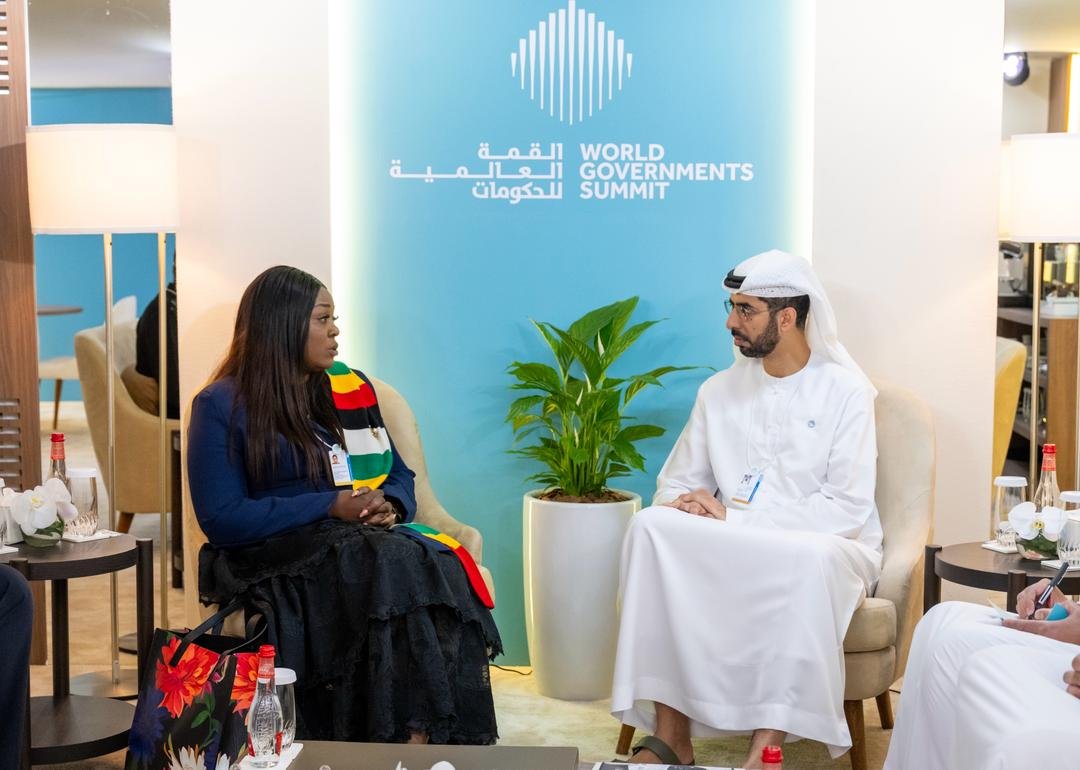
As Zimbabwe readies the launch of its National Artificial Intelligence Strategy next month, senior officials are turning to the United Arab Emirates for support in shaping a more digital, accessible state.
On Thursday morning, Zimbabwe’s Minister of ICT, Postal and Courier Services, Hon. T. A. Mavetera, met with Omar Sultan Al Olama, the UAE’s Minister of State for Artificial Intelligence, Digital Economy and Remote Work Applications, and Vice Chair of the World Government Summit.
The talks focused on potential UAE backing for AI development and the modernization of Zimbabwe’s e-government systems, including mobile platforms aimed at improving public service delivery and citizen engagement.
The discussions fall under the Government Experience Exchange Programme, a cooperation framework that previously supported Zimbabwe’s 1.5 Million Coders Programme, an effort to rapidly expand digital skills across the country.
Zimbabwe’s digital ambitions come amid structural challenges: limited internet penetration, uneven infrastructure and gaps in advanced technical capacity. Still, the government has positioned technology as central to its long-term economic vision, anchored in its Smart Zimbabwe 2030 agenda.
Mr. Al Olama, appointed in 2017 as the world’s first AI minister, has helped position the UAE as a global leader in state-driven digital transformation.
Minister Mavetera underscored the need to expand capacity-building initiatives, particularly in cutting-edge tech domains, and to strengthen institutional frameworks that support digital transformation at all levels of government.
The UAE, for its part, is positioning itself as a bridge between emerging digital markets and global technology ecosystems, offering Zimbabwe access not only to expertise but also to international networks that can catalyze research, policy design and public-private partnerships.
As Zimbabwe prepares to unveil its National AI Strategy, today’s engagement with the UAE signals a broader regional trend: governments in Africa and the Gulf are increasingly viewing AI and digital governance ecosystems as central to economic resilience, job creation, and global competitiveness.
Whether the strategy will deliver on its broad promises — transforming bureaucratic service delivery and unlocking new growth sectors — will hinge on implementation beyond Harare’s conference rooms, in the towns, farms and classrooms across Zimbabwe that stand to be reshaped by the coming digital wave.
