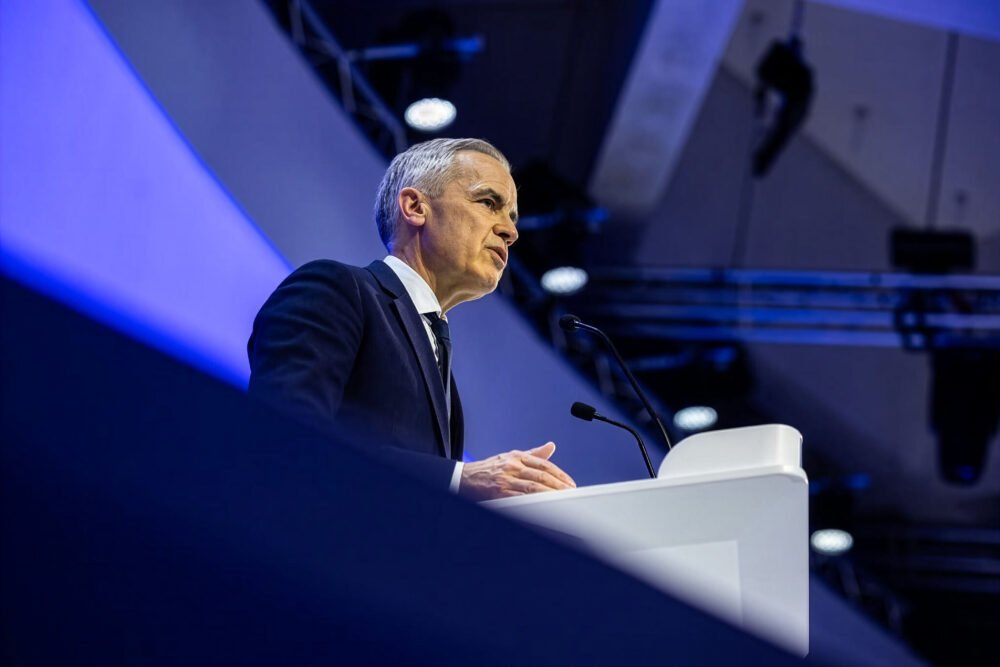
Mark Carney’s address at Davos has been widely received as a moment of truth-telling. In a world where political leaders often rely on euphemism and denial, it was striking to hear a Canadian prime minister acknowledge, plainly, that the so-called “rules-based international order” has been applied selectively. He conceded that powerful states have exempted themselves when it suited them; that rules are enforced unevenly depending on who is accused or harmed; and that the language of universal values has often concealed coercion.
This diagnosis is not wrong. It is long overdue. But what matters is not only what Carney says.
It is what his speech reveals about where the West is willing to locate the crisis,and what kind of “reset” it is prepared to pursue. Carney invokes Václav Havel’s image of the greengrocer who displays the slogan “Workers of the world unite” in his shop window as a signal of compliance. The greengrocer does not necessarily believe the slogan; he displays it to survive.
Read Full Article on Mail & Guardian
[paywall]
Havel describes this as “living within a lie”. Carney urges countries and companies to “take their signs down”, framing this as a moral turning point and an invitation to live “within the truth”. The rhetoric is compelling but it is also revealing.
The symbol Carney selects to represent falsehood is not the flag of empire, the branding of global finance or the diplomatic cover that shields powerful allies from consequence. It is a worker’s slogan. Even in a speech that gestures towards reform, the moral lesson is subtly directed downwards.
The world is invited to embrace “truth” but the first sign to be removed is the language of labour and solidarity. This is not a trivial choice. It tells us which anxieties are permitted at Davos and which remain unspeakable.
It signals whose interests the proposed “reset” is ultimately designed to stabilise. Carney speaks candidly about coercion: the weaponisation of trade, the use of tariffs as leverage, the role of financial infrastructure in enforcing compliance. He calls for “strategic autonomy” and new coalitions of so-called middle powers.
Yet he presents these dynamics as recent distortions of an otherwise sound system, rather than as the predictable outcome of a global economic order built to concentrate power, extract value and enforce obedience when persuasion fails. Coercion is not a flaw in the system. It is how the system maintains itself.
This raises the central question his speech leaves unanswered: who is protected and who is ignored? Carney’s language is clearest and most urgent when the threatened sovereignty lies within the white world. He speaks firmly about Greenland and Denmark, positioning Canada as a defender of territorial integrity in the Arctic.
He names the danger directly, calls for security measures and leaves no ambiguity about who deserves solidarity when power encroaches. Yet as a catastrophic assault unfolds in Gaza, in full view of the world, this clarity disappears. The urgency fades.
The moral courage, we are told, becomes complicated. As a South African, this pattern is familiar. Conscience often awakens not because oppression has become newly visible but because instability has begun to feel contagious.
Violations of international law are tolerated when they occur in distant places, against people long treated as disposable. But when the precedent threatens the political geography of the West itself, the rules suddenly matter. Sovereignty becomes sacred.
Coercion becomes a threat to “order”. South Africa did not approach this crisis as an abstraction. We approached it as practice, and at risk.
We took Israel to the International Court of Justice because we believe international law must apply to the powerful as well as the weak. That decision was not symbolic. It carried political and economic costs.
It is precisely the kind of choice Carney claims the world must make if it is serious about living “within the truth”. We were not alone. States across the Global South and beyond have stepped forward to defend a simple principle: that mass atrocity cannot be shielded by alliances; that victims do not become less human because their oppressor is powerful; and that international law cannot mean anything if it is selectively applied.
[/paywall]
All Zim News – Bringing you the latest news and updates.
