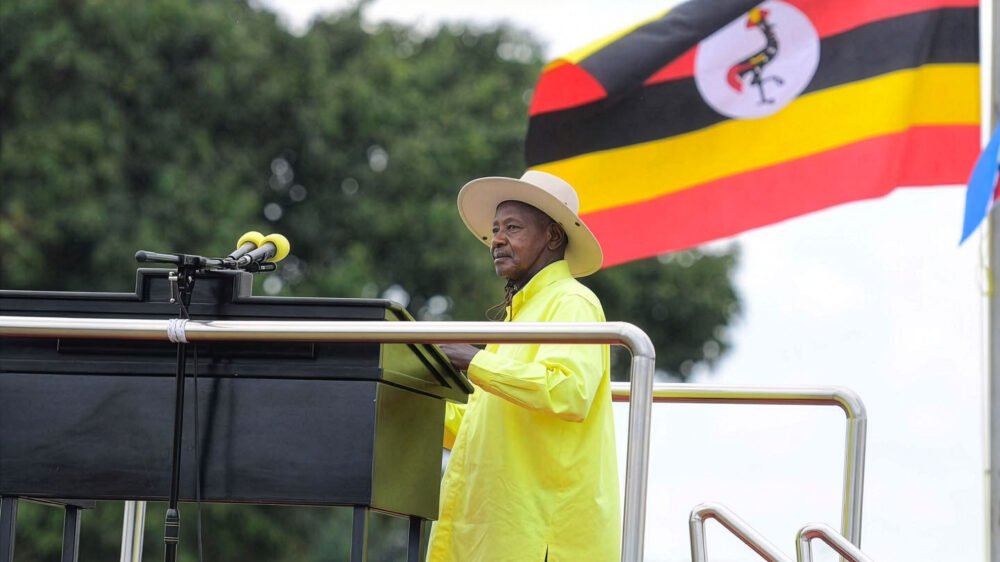
In a country that has never witnessed a peaceful transfer of power since independence in 1962, Ugandans braved an internet shutdown, fear, anxiety and heavily armed security deployment to cast votes for the president and parliamentary seats on 15 January 2026. Article 1 of the 1995 Uganda Constitution (power belongs to the people) guides citizens to choose their own leaders, from the president to local councils, every five years. Out of an estimated population of 49 million, the Uganda Electoral Commission registered 21 649 068 voters, among whom 11 366 201 votes were cast, with 11 090 848 valid and 275 353 invalid, at 50 739 polling stations, projecting a 52% voter turnout.
The same commission electoral-engineered 7 946 772 votes, projecting 71.65%, allocated to Yoweri Museveni in first place and Robert Kyagulanyi Ssentamu (aka Bobi Wine) with 2 741 238 votes, projecting 24.72%, in second place. Other participants, such as Nandala Mafabi with 209 039 votes and 1.88%, Mugisha Muntu with 59 276 votes and 0.53%, Bulira Frank with 45 959 votes and 0.41%, Robert Kasibante with 33 440 votes and 0.30%, Munyagwa Mubarak with 31 666 votes and 0.29% and Mabirizi Joseph with 23 458 votes and 0.21%, were reported as official figures, respectively. As guided by Article 103, Section 7 of the 1995 Constitution, the electoral commission chairperson, Justice Simon Byabakama, declared the incumbent, 81-year-old Museveni, as the winner of the 2026 presidential race for a seventh elective term, taking his tally from 40 to 45 years in power.
Amid the electoral commission declaring Museveni the winner, the first runner-up and Uganda’s main opposition leader, Bobi Wine, of the National Unity Platform, rejected the results as fabricated and fake, categorically stating that the electoral commission results do not reflect the will of the people of Uganda. One of the obvious cases backing Bobi Wine’s statements was the glaring lack of transparency in vote tallying and the final results reporting at the national tallying centre and, most importantly, the malpractices that transpired throughout the entire election cycle. Bobi Wine’s point of view resonates with millions of Ugandans across the spectrum, international observers and media powerhouses.
Read Full Article on Mail & Guardian
[paywall]
An election must seem transparent, free and fair to all contenders, citizens and observers, otherwise, it ceases to be credible, thereby subjecting it to rejection, legal gymnastics and civil unrest. Former Nigerian president Goodluck Jonathan, who led the delegation of observers from the African Union, in his report, raised similar shortcomings in Uganda’s 2026 elections and the uphills of democracy in Africa. A credible, free and fair election is one of the tenets of democracy. However, without fear of contradiction, Uganda’s 2026 elections were marred by glaring electoral irregularities and malpractices, use of disproportionate force, voter suppression and human rights violations from the beginning of the exercise to the end.
[/paywall]
