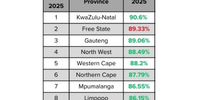
The record matric pass rate does not hide the shortcomings of the education system, but at least we are following the correct path. The announcement of the matric pass rate raised many eyebrows. Few experts predicted that the class of 2025 would improve on their predecessors’ 87.3%.
You have to take your hat off to this class that was welcomed into Grade 8 during the Covid pandemic. Their passionate teachers, who refused to give up, also deserve a pat on the back. “Are these results for real?” was the question I had to answer repeatedly in numerous radio and television interviews.
My short answer: Yes. Prof Yunus Ballim and his team command respect. The Class of 2025’s pass rate of 88% is therefore a historic best.
Read Full Article on Daily Maverick
[paywall]
For the longer answer, I had to conduct an in-depth study of the results. The matric results are not a standalone entity. What happens in primary school determines the matric pass rate.
To quote the Minister of Basic Education (DBE), Siviwe Gwarube: “Matric is not an exam; it is a journey.” Therefore, the Director-General of the DBE, Hubert Mathanzima Mweli, emphasised that matric results were part of the National Development Plan 2030 (NDP), a strategic framework aimed at eradicating poverty and inequality by 2030. From an educational perspective, the NDP seeks to give all learners access to quality teaching and training, which will lead to improved learning and performance. This comprehensive action plan focuses on the country’s socioeconomic development.
It addresses the country’s challenges and seeks to come up with solutions for a more inclusive society. Mveli highlighted the following social justice principles by which progress in education should be measured: I will now analyse this year’s matric results based on these six principles. Education is a massive operation that provides instruction to 13.7 million children in 25,400 schools with the help of 470,000 teachers.
For the matric exam, 11 million exam scripts were marked by about 65,000 markers at 192 marking centres. When one looks at the numbers, it seems as if many girls who fell pregnant returned to school, because almost 100,000 more girls than boys wrote matric. They also perform better than boys.
There is growing concern about boys; so much so that President Ramaphosa has expressed his concern about the decline in the number of boys in the system. In a country with so many inequalities, part-time candidates are a given. That this number is starting to decline (only 93,000 out of 137,776 registered showed up) is an indication that matriculants prefer the full-time system.
Repeating matric ensures quality teaching and better marks, and eventually a better future. The high dropout rate still seems to be the department’s Achilles’ heel. There will always be questions about the accessibility of education in South Africa when only 778,000 of the 1.2 million children who started in Grade 1 finish matric.
What happened to the other 450,000 (47%) learners? Also, nearly 18,000 of the 764,014 full-time candidates who registered never showed up to write the exams. Were they held back to preferably write the part-time exams so that the results of certain schools and provinces would look better?
[/paywall]
