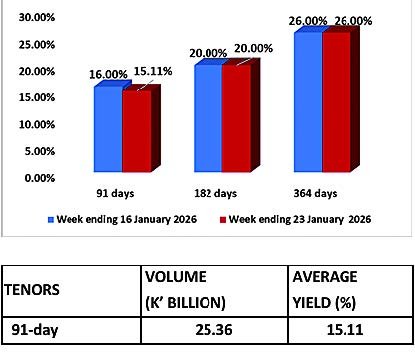
For three consecutive weeks, the Malawi Government has rejected Treasury bills (T-bills) bids in a move fiscal and monetary authorities say is meant to tame appetite for domestic borrowing and prioritise fiscal consolidation and debt sustainability. Since the onset of this year, government has rejected T-bills bids on January 6 valued at K47.8 billion and also rejected K69.7 billion the following week. On January 20, government further turned down bids valued at K55 billion, with only K11 billion for the 90-day tenor allotted, in the process pushing the yield rate down to 15 percent from 16 percent while other 182-days and 364-day tenors remained unchanged at 20 percent and 26 percent, respectively.
During last week’s auction, K25.36 billion was raised from applications worth K201.04 billion, resulting in an 87.39 percent rejection rate. This means that for the past three weeks, government has rejected T-bills bids valued at K348 billion. In an interview on Friday, Reserve Bank of Malawi (RBM) spokesperson Boston Maliketi Banda said government seeks to reduce its appetite for high borrowing costs amid elevated domestic debt levels at about K14 trillion, which is 65 percent of the total public debt at K22 trillion, an equivalent of 86 percent of gross domestic product (GDP).
He said: “The Government of Malawi has recently signalled a shift in its borrowing strategy, prioritising fiscal consolidation and debt sustainability. “With domestic debt already at elevated levels, further borrowing at high yields would exacerbate debt servicing costs and strain the national budget.” Maliketi Banda said by scaling back its participation in high-yield T-bills auctions, the government has effectively reduced demand for high-cost debt, leading to lower yields. Minister of Finance, Economic Planning and Decentralisation Joseph Mwanamvekha said on Friday that the rejection is a deliberate move to induce a decline in interest rates and reduce domestic borrowing and interest rate payment.
[paywall]
He said: “We are rejecting T-bills bids and we will continue rejecting them. This is meant to cut interest rates, to reduce domestic borrowing and enable banks to increase their lending to the private sector. “If we reduce borrowing, we will be reducing our debt burden, reduce interest payment and guarantee increased private sector credit, which could spur economic growth.” Business Partners International country manager Bond Mtembezeka said in an interview on Friday that government’s move is synonymous with the current regime, which targets to lower interest rates and exercise fiscal discipline. “They have been rejecting higher yields as a way of compelling bidders to reduce their interest rates and this can have a signalling effect on financial markets,” he said
[/paywall]
