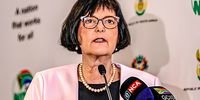
The minister of transport, Barbara Creecy, has called for national action on scholar transport safety following the minibus taxi crash in Gauteng that claimed the lives of 12 learners. Just days earlier, metro police in Nelson Mandela Bay intercepted a 16-seater vehicle carrying 40 people — predominantly schoolchildren. Three days before Monday’s horror scholar transport crash in Gauteng, which claimed the lives of 12 learners, the Nelson Mandela Bay metro police stopped a massively overloaded minibus transporting 40 passengers — most of them schoolchildren from Nelson Mandela Bay’s Northern Areas.
Minibus taxis have a maximum passenger capacity of 16. Metro police said the 27-year-old driver, who had an expired professional driving permit, attempted to evade the checkpoint and nearly collided with a metro police officer. He was arrested and charged with reckless and negligent driving, failure to comply with a lawful instruction, and overloading.
He has since been released on warning. Following Monday’shorror crash, in which 12 learners were killed near Vanderbijlpark in Gauteng, the minister of transport, Barbara Creecy, and her deputy, Mkhuleko Hlengwa, on Tuesday said they had instructed traffic law enforcement agencies to intensify their law enforcement operations nationally with a specific focus on scholar transport. Creecy and Hlengwa stressed that they want traffic officials to focus on overloading, roadworthiness and speeding.
Read Full Article on Daily Maverick
[paywall]
They said there would be a “zero tolerance attitude” that would include lawlessness and non-compliance by private operators and drivers of learner transport. They ordered that unroadworthy scholar transport vehicles be impounded and reckless drivers arrested, and said they would make unannounced visits to inspect scholar transport vehicles countrywide. The Department of Transport is in the final stages of reviewing the National Learner Transport Policy to tackle crucial issues relating to the safety of learner transport and access to reliable scholar transportation.
Creecy and Hlengwa said the policy would be presented to the Cabinet for approval in due course. “However, [the department has] stated that unroadworthy vehicles have nothing to do with the policy. Operators and associations must obey the rules of the road and ensure that their vehicles are roadworthy,” Creecy and Hlengwa warned.
Their warnings came as the South African Human Rights Commission released its report on the state ofscholar transport in North West. It found that “the majority of scholar transport services are characterised by vehicle overloading, the use of unroadworthy and unsafe vehicles, frequent breakdowns, and late collection and delivery of learners”. The Unesco “Oliver Tambo” chair of human rights at the University of Fort Hare, Dr Siyabulela Fobosi, is regarded as one of the country’s foremost researchers in informal transport services. Having grown up in a rural area in the Eastern Cape, he knows the long distances learners without scholar transport must walk and the perilous nature of scholar transport.
[/paywall]
