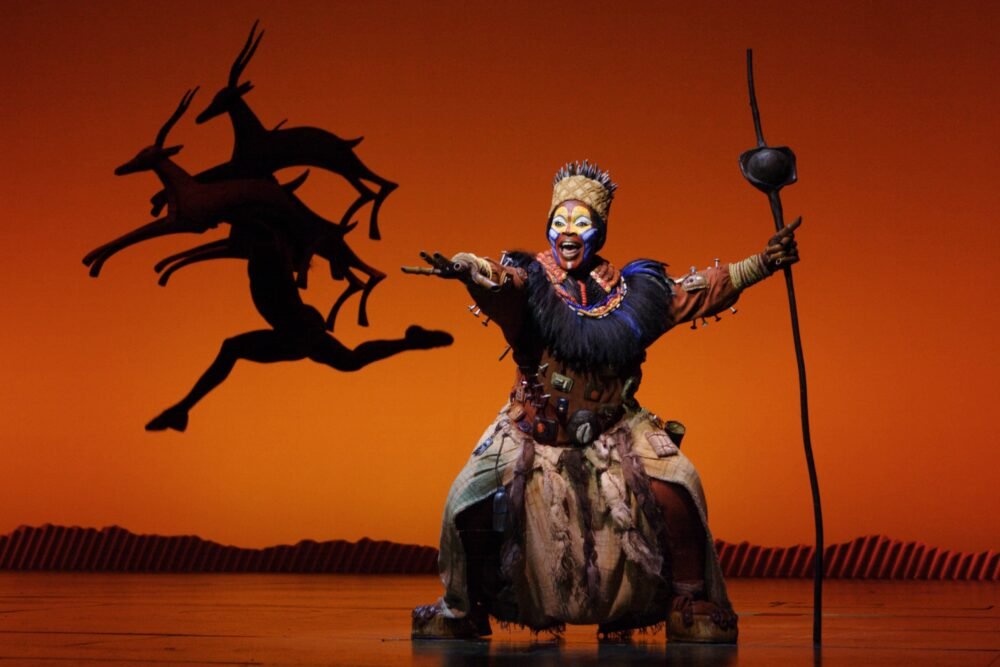
The curtains lifted and the sun rose on the stage of London’s Lyceum Theatre as the iconic opening lines of theCircle of Life in Disney’s The Lion King“Nansi ingonyama bakithi baba” reverberated through the theatre. The thundering voice of Thenjiwe Nofemele, a South African actress who plays Rafiki, commanded silence and attention from the 2000 people seated in the cool theatre on a Sunday afternoon. The stage began to transform as performers convincingly dressed as animals glided across the platform.
Each in their embellished costumes, face paint and movement mimicking the eagerness and curiosity of the wild. A 4m-long and 3m-wide elephant carefully carried by four actors walked down the orchestra aisle, followed by giraffes carried on stilts and other antelope galloping onto the stage. A spectacle.
The character details, the design of the stage, the choreography and the theme music carried the essence of the iconic opening scene where animals gathered around Pride Rock to welcome the young king’s birth. As the Zulu chant translates: “Here comes a lion, father”. Rafiki held baby Simba to the sky and the unmistakable thud that brought the theatre to complete darkness and brought the scene to a close.
Read Full Article on Mail & Guardian
[paywall]
It was silent. Shivers tingled across my body and eyes welled with tears. The audience roared in applause in anticipation of the magnificent treat we were about to experience.
The Lion Kingwas released in 1994 and has become a favourite of adults and children across the globe. The production was directed by Julie Taymor and has been running at the Lyceum Theatre in London for 26 years. The production recently won the best musical production in the Black British Theatre Awards and boasts a crew of over 150 people, which includes the main actors, performers and puppeteers as well as the backstage crew that brings it together.
The magic lies in the story-telling, but the dressing brings the story to life, with over 350 costumes in the show, including 22 hand-beaded corsets, each consisting of thousands of individually sewn beads, as well as 232 puppets in the show, including rod, shadow and full-sized puppets. The story is set in the African Savannah and five African languages are spoken or sung in the show: Sesotho, Kiswahili, isiZulu, Setswana and isiXhosa, but it was a surprise for me, a South African visiting London, to hear Rafiki utter the words “Haibo” during a scene. I had to prop my head up to make sure I was correct in hearing a South African term in a foreign country – let alone a big stage production.
It was later confirmed when the same character said “sanibonani” in another scene. It felt comforting and warm to hear my country’s language being represented and shown to the rest of the world. Having grown up watchingThe Lion King, the story, dialogue and scenes were so familiar to me that I unconsciously started mouthing the words and singing along to the songs.
I watched the production with more intent as I sought more South Africanness. It was exquisite in the way the stage transformed scene after scene – from the colour and vibrant duet between young Simba and Nala in I Just Can’t Wait to be King, to the chilling moment Scar drops Mufasa to his death as drums throbbed and as Simba transitions from cub to lion with his two new companions, Timon and Pumbaa. It was not just a visual or auditory treat, but an emotional experience and to have South Africans playing key characters was notable given the variety of stage shows produced in London, including classics such as Moulin Rouge and Hamilton.
“WithThe Lion King, it’s very specific. South Africans need to be in the show because it’s rooted in our culture and heritage. It’s not just the London company – productions all over the world need that South African sound, because much of the singing is in our languages. That authenticity is vital,” said Nofemele.
[/paywall]
