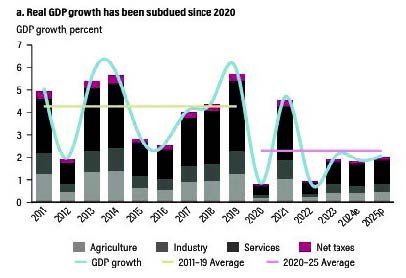
Malawi’s economic growth outlook remains modest and increasingly contested with projections from both international institutions and government pointing in different directions. The World Bank January 2026 Global Economic Prospects shows that the country’s economy was estimated to have grown by 1.9 percent in 2025, with growth projected to rise to 2.6 percent in 2026 and 3.1 percent in 2027. While the outlook suggests gradual recovery, Malawi remains among the slowest-growing economies in sub-Saharan Africa.
The bank’s forecast reflects marginal changes from its June 2025 outlook, with Malawi’s 2026 growth projection revised upward by 0.2 percentage points while projections for 2025 and 2027 were revised downward by 0.1 percentage point each. In an interview on Sunday, University of Malawi economics lecturer Edward Leman said the projections are largely unfavourable in view of the aspirations outlined in Malawi 2063, the country’s long-term development plan. But he said the projection offers an important opportunity for policy reflection, analysis and adjustment.
Said Leman: “Achieving Malawi 2063 objectives requires average annual growth of at least six percent yet current projections suggest that the assumptions underpinning such growth may no longer hold, thereby calling for a thorough reassessment of the policies and implementation strategies. “If these projections materialise, they could imply prolonged stagnation in growth and development.” He said in view of the interdependence of macroeconomic fundamentals, weaker growth can translate into lower government revenues, persistent inflationary pressures, higher unemployment and declining welfare outcomes. Malawi Economic Justice Network executive director Bertha Phiri said in an interview on Sunday that repeated gaps between projections and outcomes have eroded confidence in fiscal planning.
[paywall]
She said: “We have always observed challenges with the credibility of macroeconomic assumptions. “Year in, year out, we see over-expected revenue collection, rigid expenditures and rising public debt that curtail fiscal space.” Phiri warned that optimistic growth assumptions have not translated into improved service delivery. “The budget does not comprehensively tie to the Malawi 2063 model,” she said, arguing that weak policy coherence undermines growth-led development.
[/paywall]
