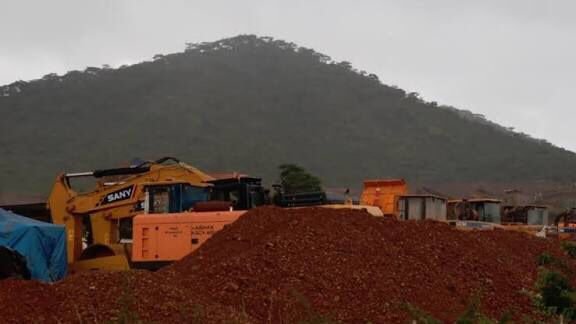
In the hills of Penhalonga, where order has only recently returned after years of chaos brought by illegal mining, an extraordinary campaign is now unfolding — one that residents say is aimed not at protecting the community, but at dismantling it for naked political ends.
At the centre of the storm stands Toronto Mine, whose owners are widely credited with restoring stability to an area once ravaged by uncontrolled panning, criminal syndicates and environmental destruction. For many locals, the arrival of formal mining operations marked the end of lawlessness and the beginning of dignity.
“Before this mine came, this place was a jungle,” said a grey-haired villager who has lived in Toronto for more than three decades. “Illegal miners destroyed our roads, polluted our streams and brought crime. Young girls were not safe. Since the owners came and chased them away, we have peace again.”
The mine was first registered in 1973 under a multinational company Lonrho.
Residents say that at the height of the chaos, more than 20 illegal miners were arrested in joint operations with the police after terrorising the community.
“They were robbing people in broad daylight,” recalled a local shopkeeper. “They broke into houses, stole goats, phones and money. Some of us were assaulted. When the mine owners came and worked with the police, more than 20 of those criminals were arrested and taken away. That is when peace returned.”
Yet, despite this record, a growing campaign led by civil society activists has sought to portray the mine as an enemy of the people — a move residents now say is being orchestrated by the Centre for Natural Resources Governance (CNRG) as part of a wider political project aimed at weakening Zanu PF and undermining empowerment initiatives.
Community leaders allege that CNRG has been instrumental in forming residents’ associations designed not to represent local interests, but to act as parallel political structures hostile to the ruling party.
“This is not a coincidence,” said a senior village head. “They came with ready-made committees, ready-made positions and instructions. They told us clearly this structure must confront Zanu PF and the mine. That is politics, not community work.”
What has further alarmed residents is the background of CNRG’s director, Farai Maguwu, whom critics describe as a long-time opponent of large-scale mining development in Zimbabwe.
Community leaders say Maguwu has previously led campaigns against diamond mining in Marange and other strategic mineral projects across the country, often calling for the suspension of operations and international sanctions against local mining ventures.
“Wherever there is mining and empowerment, his name appears,” said a senior local official. “From diamonds to gold and now here, his position has always been to fight mining development. People must ask why he consistently targets projects that create jobs and strengthen communities.”
Another resident added: “He has made a career out of opposing mining. Now he has come to Toronto to destroy a project that saved us from criminals.”
What has shocked many in Toronto is the sheer size and sophistication of the association that has emerged in a settlement of only a few hundred plots. Residents say the structure is now bigger and more complex than residents’ associations in Harare and Bulawayo — a startling development for such a small area.
“In Harare and Bulawayo, with thousands of households, you do not even see this kind of organisation,” said a former committee official who later resigned. “Here we have departments of governance, security, publicity, mining, finance, energy and economic planning. This is a government in waiting, not a residents’ association.”
Church leaders echoed the concern.
“Which small community needs a governance department and a publicity department?” asked a local pastor. “This is a clear sign that the intention is political. They are building structures to fight Zanu PF, not to serve residents.”
Residents have also questioned the priorities of the civil society groups now so active in Toronto.
“For years we begged for help to form a neighbourhood watch committee because criminals were terrorising us,” said a community elder. “Nothing happened. No NGO came to help us protect our homes. But now, suddenly, they have energy to build a huge residents’ association with political departments. That tells you everything.”
Another resident was blunt: “They did not help us fight thieves and illegal miners. They only came when there was politics to be done.”
A senior Zanu PF leader in Manicaland disclosed that he was quietly approached to join the association, but walked away after sensing its true agenda.
“They tried to include me in their structures,” he said. “When I attended the meeting, it became obvious that this was formed to fight my party and attack the mine. I told them I would never join a group created to undermine Zanu PF under the cover of residents’ affairs.”
He added: “The sad part is that some people who were recruited do not even know what this is really about. They think it is about development, yet they are being used for politics.”
Indeed, several residents now admit they joined the association innocently, only to later withdraw after discovering its partisan undertones.
“We were told it was about unity and community development,” said a young mother from the compound. “Later the meetings became about mobilising against Zanu PF. That is when I realised this was not for me.”
Across Toronto, gratitude towards the mine owners runs deep.
A former illegal miner, now formally employed at the site, spoke with quiet pride. “I used to run from the police and sleep in the bush,” he said. “Now I have a contract, safety equipment and a salary. These owners saved many of us from a life of crime.”
Women traders echoed the same appreciation.
“When the illegal miners were here, there was violence and drunkenness every night,” said a vegetable vendor near the compound. “Now it is organised, there is security, and business is good. We sleep peacefully.”
Traditional leaders confirm that the mine owners played a decisive role in clearing out destructive syndicates that had turned the area into a haven of disorder.
“They worked with authorities to remove illegal miners who were destroying land and terrorising villagers,” said a respected headman. “That is development. That is responsible investment.”
Attention has increasingly focused on CNRG, whose director Farai Maguwu has led public attacks on the mine. Residents accuse the organisation of deliberately ignoring the havoc caused by illegal mining while targeting lawful operations that have brought jobs and order.
“They never came when more than 20 illegal miners were being arrested for robbing us,” said a mine supervisor. “Now that there is discipline and employment, suddenly they appear with politics.”
Former members of the residents’ association say they withdrew after realising the group’s true purpose.
“We were instructed to mobilise against the mine and against Zanu PF,” said one ex-official. “There were even security and publicity committees. That is a political party, not a residents’ association.”
Government officials in Manicaland have privately expressed concern over what they describe as “the weaponisation of civic platforms”.
“This is a classic strategy — build oversized structures in small communities, disguise them as residents’ associations and then use them to mobilise politically,” said one senior official.
For ordinary residents, the matter is painfully simple.
“These mine owners gave us back our community,” said an elderly woman, watching her grandson leave for his shift. “They chased away criminals, helped arrest thieves, gave our children work and restored peace. We will not allow NGOs to destroy that for politics.”
