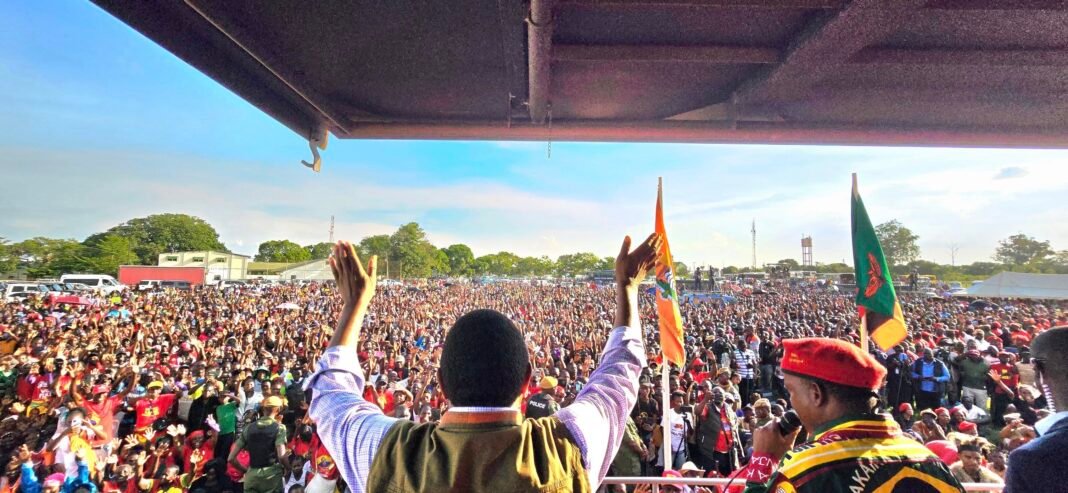
NdomuThe first major public engagement of Zambia’s 2026 election year did not begin in Lusaka. It began in Choma, deep in Southern Province, where politics is not merely contested but inherited. At the Choma Cricket Club grounds on Wednesday, a sea of supporters drawn from all 15 districts gathered to receive a President returning from deliberate political quiet into full view.
Cabinet Ministers, ruling party lawmakers, opposition figures, independents, civic leaders and traditional authorities stood shoulder to shoulder as Hakainde Hichilema made his first major electoral-era appearance of the year. Security was visibly heightened, not as spectacle, but necessity. The crowd was large, expectant, and unmistakably at home.
The President arrived to traditional drums and dances heavy with ancestral symbolism. Dancers waved wooden spears and cow tails, invoking cattle wealth and heritage. The address that followed was delivered predominantly in Tonga, the dominant local language, reinforcing both cultural proximity and political ownership of the space.
Read Full Article on Lusaka Times
[paywall]
It was not accidental. Hichilema spoke with confidence, framing his first term as a period of repair after what he described as one of the most severe economic depreciations in Zambia’s recent history. He pointed to stabilising macroeconomic indicators, including the strengthening of the Kwacha against major currencies, revived mining operations, and reforms in agriculture and energy.
Free education featured prominently, presented not as policy rhetoric but as an irreversible social investment. On mining, the President said reforms were now “trickling down” to ordinary citizens, linking sector recovery to household-level impact. Mines and Minerals Development Minister Paul Kabuswe echoed this, citing the training of over 1,000 small-scale miners on the Copperbelt in safe and legal practices as part of a broader effort to formalise the sector and stimulate local economies.
The political undertone sharpened as the rally progressed. Southern Province Members of Parliament collectively endorsed Hichilema as the sole presidential candidate of the UPND for August 2026, presenting a unified front from a region that has been the party’s strongest base since the era of Anderson Mazoka. The President reminded the crowd that the province holds close to 1.2 million registered voters and urged turnout discipline, warning against what he described as the return of cadreism, political violence, and tribal mobilisation under a divided opposition.
What distinguished this rally was not only message but mood. Hichilema appeared hyper, animated, even dancing on the platform, evoking memories of the 2021 campaign trail. The difference now is status.
He enters this cycle as an incumbent, with state authority, institutional reach, and a party that has governed its way through crisis into relative stability. Behind the scenes, aides describe the President’s recent low profile as intentional. While public discourse has been consumed by church–state tensions and opposition mobilisation around symbolic issues, UPND operatives have been active in less visible terrain.
Northern Province, long considered PF heartland since the days of Michael Sata, has become a strategic focus. Political adviser Levy Ngoma has been camped in the region, quietly consolidating support, engaging local leadership, and testing the durability of green strongholds. With Parliament now expanded to 226 constituencies under the amended framework, the 2026 contest is shifting from noise to arithmetic.
Multiple sources familiar with ruling party strategy say UPND believes it can secure upward of 140 parliamentary seats if current opposition fragmentation persists. The objective, they say, is not domination through rhetoric but accumulation through structure.
[/paywall]
