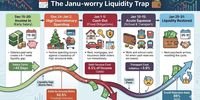
South African households face a predictable post-festive squeeze as debt, school fees and transport costs converge in early January, amplified by high household debt and structural timing gaps between income and essential expenses. As the final week of December 2025 draws to a close, South African households are entering a familiar, if under-explained, period of acute financial strain. While the celebratory atmosphere of the festive season lingers, the systemic gears of the national economy are already shifting toward January’s obligations.
For many, the coming weeks will feel more constrained than December – not necessarily because of reckless holiday spending, but due to a structural timing mismatch between income and essential expenditure. This “January shock” is often framed as a personal failure of budgeting, yet data suggests it is a predictable outcome of systemic financial cycles. As debit orders resume, school fees fall due and work-related costs reappear, the gap between these obligations and the next salary date exposes the underlying vulnerability of the South African consumer balance sheet.
The primary driver of this pressure is a simple but brutal cash-flow misalignment. Many employees receive their December salaries earlier than usual, creating a non-working period that can stretch up to six or seven weeks before the next paycheck arrives in late January. Against this elongated timeline, households face a concentration of fixed obligations.
Read Full Article on Daily Maverick
[paywall]
Insurance premiums, loan repayments and subscription fees typically fall due in the first days of the new year. Education costs – ranging from school fees to uniforms and stationery – loom large. At the same time, returning to work brings immediate transport and fuel expenses, which analytical estimates suggest rose around 3.9% in early 2025, combining Department of Mineral Resources and Energy adjustments and South African Reserve Bank (Sarb) inflation reporting.
These costs, while seemingly incremental, immediately chip away at limited disposable income. Data from theTransUnion Consumer Credit Indexfor the first half of 2025 underscores just how thin the margin for error has become. Estimated national household debt remains elevated at about 62.7% of disposable income, aligning withTradingEconomics figures, which show the ratio hovering above 62% – well above the long-term historical average of 52.3%.
When debt absorbs nearly two-thirds of a household’s income, even small disruptions, such as unexpected school expenses or transport hikes, can trigger liquidity strain. January does not create this vulnerability; it simply exposes it. South Africa’s R2.43-trillion consumer debt further explains why households are locked into rigid payment schedules.
According to the National Credit Regulator’sConsumer Credit Market Report (Q1 2025), mortgages account for the largest share at R1.26-trillion, secured credit – including vehicle finance – makes up R534.5-billion, and unsecured credit and facilities such as personal loans and credit cards collectively exceed R550-billion. The report also notes that roughly two-thirds of applications for new credit are rejected, suggesting that consumers seeking emergency January financing are often already stretched to their limits. This stress is not merely seasonal but persistent. TheNational Credit Regulator Annual Report 2024/2025indicates that a growing number of credit-active consumers operate under significant pressure, particularly low- and middle-income households.
[/paywall]
