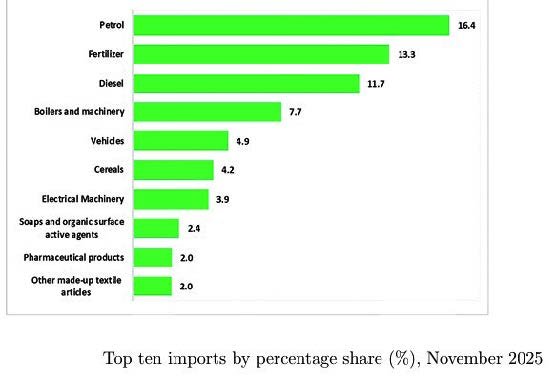
National Statistical Office (NSO) data show that Malawi’s cumulative trade deficit in the 11 months to November this year jumped by 20 percent to $2.4 billion (about K4.2 trillion) compared to $2 billion (about K3.5 trillion) during the same period last year. In its latest International Merchandise Trade Statistics, NSO data show that during the review period, imports were recorded at $3.27 billion (about K5.7 trillion) from $2.91 billion (about K5 trillion) during the same period last year while exports peaked at $875.4 million from $882.8 million (about K1.5 trillion) in 2024. The data further show that in November alone, the trade gap widened to $238.9 million (about K418 billion) from 228.7 million (about K400.6 billion) in October, indicating that imports that comprise fuel, fertiliser and pharmaceuticals continue to dwarf exports that include tobacco, tea and pulses.
Reads part of the report: “Total exports for November 2025 amounted to $109.4 million [about K191 billion], showing a 26.7 percent decrease compared to $149.1 million [about K261 billion] in November 2024. “In contrast, total imports increased from $301.2 million [about K527 billion] in November 2024 to $348.3 million [about K609 billion] in November 2025 and this reflected a 15.6 percent increase.” In an interview yesterday, Mzuzu University economics lecturer Christopher Mbukwa said the widening trade deficit reflects both structural and transactional weaknesses in the economy. He said: “The reason for the increased trade deficit is the drop in sales of tobacco, groundnuts and tea.
“The rise in this deficit can be attributed to transactions that were done in kwacha this year as opposed to the traditional dollar transactions over the years.” Despite the widening trade gap, Malawi’s foreign exchange reserves slightly improved in October 2025, standing at $526.8 million (about K921 billion), equivalent to 2.1 months of import cover from $511.8 million (about K894 billion) or two months of import cover in September. Scotland-based Malawian economist Velli Nyirongo said yesterday that the increase in reserves does not reflect an underlying recovery in export performance. “Export diversification, stronger value addition and efficient repatriation of export proceeds are essential to boost the country’s exports,” he said.
[paywall]
Export Development Fund managing director Frederick Chanza said the core weakness is not merely weak export receipts, but the country’s chronic failure to produce at scale. He said in an interview yesterday that the economy will remain trapped “if we keep on exporting raw commodities and importing expensive finished products”. “If we are going to restructure our trade and narrow the deficit, we must build scale. That is why we are financing industrial parks, mining projects and high-value processing,” said Chanza, whose firm is a subsidiary of the Reserve Bank of Malawi and provides export finance.
[/paywall]
