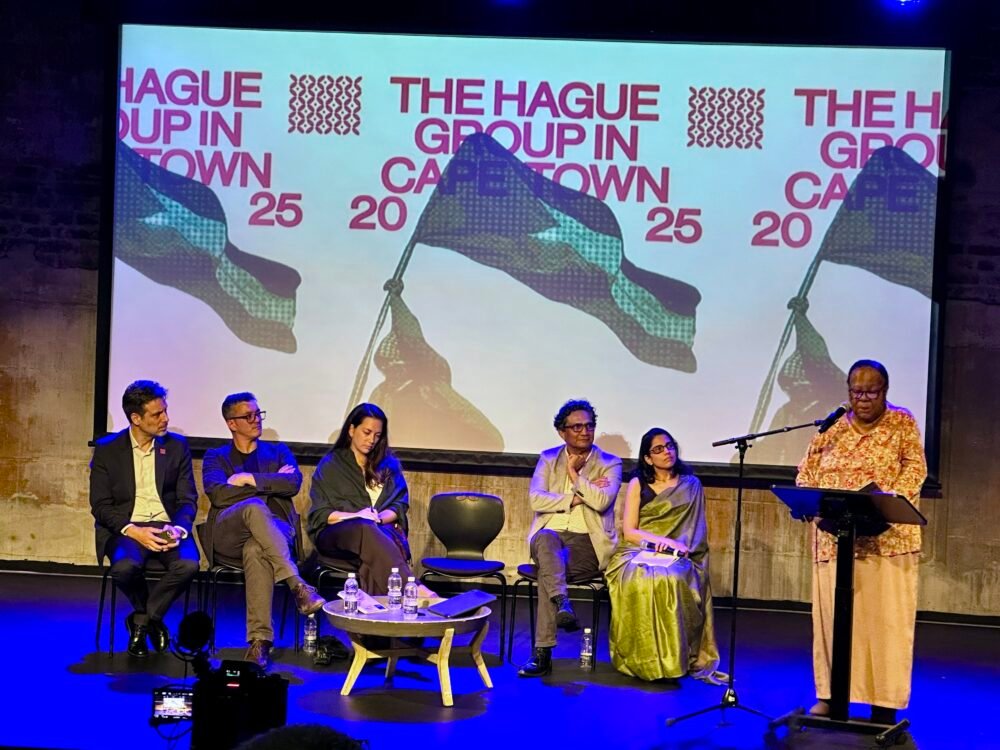
When the Hague Group convened its first public African meeting in Cape Town earlier this week, it did so as a coalition of Global South states seeking to revive the enforcement of international law in the face of Israel’s genocide on Gaza. Co-chaired by South Africa and Colombia, the group brings together states from Africa, Latin America and Asia that argue the paralysis of multilateral institutions has enabled systematic impunity. Yet the gathering unfolded against a backdrop that exposed a central tension confronting the initiative.
It was here that former international relations ministerNaledi Pandor’s intervention cut most sharply. Welcoming the formation of the group, Pandor cautioned that without confronting material complicity, the initiative risked becoming “pleasant, but ineffectual”. Her warning would soon find concrete expression in trade data showing a sharp rise in South African coal exports to Israel, even as Pretoria presses its genocide case at The Hague.
The Hague Group was established in January by South Africa, Colombia, Bolivia, Cuba, Honduras, Namibia, Malaysia and Saint Vincent and the Grenadines. Drawn from three continents with histories shaped by colonial domination, the group has committed to implementing existing international law through domestic measures, including halting arms transfers, denying port access for weapons shipments and enforcing arrest warrants against individuals accused of war crimes should they enter member states’ territories. That ambition reflects mounting frustration with the failure of global institutions to constrain Israeli conduct in Gaza.
Read Full Article on Mail & Guardian
[paywall]
Speakers described a system in which legal norms are applied selectively, allowing powerful states and their allies to evade accountability. South Africa’s case against Israel at the International Court of Justice was repeatedly cited as a turning point that challenged this exceptionalism, even as subsequent diplomatic pressure against Pretoria underscored the costs of acting alone. From the outset, organisers framed the Hague Group as an attempt to overcome that vulnerability through collective action.
Several participating countries have already faced punitive measures for positions perceived as hostile to Western interests, lending urgency to the experiment. But as discussion in Cape Town made clear, collective credibility depends on consistency. During the question-and-answer session, participants pressed panellists on South Africa’s continued export of coal and other strategic commodities to Israel, arguing that legal commitments lose force if material supply chains remain intact.
Pandor acknowledged the point, noting that coal was precisely the kind of pressure point where activism and organised labour had historically forced political change and said she had been engaging trade unions on the issue. The scale of that contradiction is stark. In the three months to October, South Africa shipped just over 660 000 tonnes of coal to Israel, enough to fill roughly six large bulk carriers, marking the highest quarterly total since 2017.
[/paywall]
