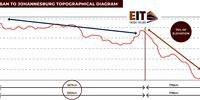
South Africa is finally waking up to the rail revolution at an industrial scale, and doing road-to-rail swaps on the Great Escarpment makes so much sense it even lured investment bankers to the Midlands. “The rail runs directly next to the road… exactly the same [number of] kilometres all the way [from the port] to here [Estcourt].
But from here [Estcourt] the rail goes around Ladysmith, all around the mountains into Joburg. And the road goes straight into Joburg up [Van Reenen’s] Pass. So the road on this last leg is about 180km shorter…
But, between our village and the port, the rail cost is a lot cheaper.” That is the geometry of South Africa’s logistics crisis, explained by EIT Group CEO Wessel Jacobs. It is a simple equation of physics versus finance that has somehow eluded state planners for decades. Jacobs is a former investment banker who specialised in rehabilitating bad businesses (business speak for cutting costs and carving up assets for sale).
Read Full Article on Daily Maverick
[paywall]
He admits the “negative environment” of retrenchments and distressed assets eventually wore him down. Now, he has transformed a site he was originally meant to rehabilitate – the old Masonite board manufacturing plant – into a silver bullet for the N3 road freight congestion. The Estcourt Intermodal Freight Village is an ambitious attempt to hack the logistically terrible topography of the country.
The concept is deceptively simple. Rail is efficient at hauling heavy loads over flat terrain, but struggles with the steep, winding incline of the escarpment. Trucks destroy the road, and themselves, trying to haul heavy loads out of the port, but they are agile enough to handle the final vertical climb up Van Reenen’s Pass efficiently.
“If I run a vehicle from Joburg into a pack house close to the Durban port and back, I can run eight to 12 loads a month, per vehicle,” he explains. “But if I run in and out of Estcourt, I run 25 to 30 loads per vehicle … which reduces the density of vehicles on the road substantially because your turnaround time is so much faster.” It’s simple numbers, not Newtonian theory: A truck can currently wait up to two days just to get into the Durban port.
[/paywall]
