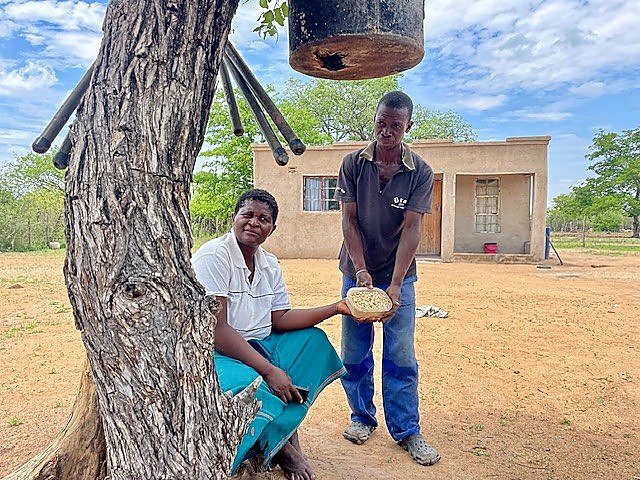
Source: The Zimbabwean
New types of ranching on medium-scale land reform farms in Matobo, Zimbabwe.
The A2 farms in Matobo are in some of the most remote parts of the district. These are predominantly livestock farming areas, with cattle being the dominant livestock type. Getting to these areas in the rainy season requires a four-wheel drive, skilled driving and much patience.
The farms have been carved out of huge ranches with an average of 2800 hectares, with current farms being around 486 ha on average. The other medium-scale farms in the area – which we combine in our analysis with A2 farms – are so-called three-tier farms with average sizes of 302 ha, which were allocated by the district council prior to the land reform.
Most farms in our sample are not inhabited permanently by the farm owner, although this has shifted over time as owners have retired from jobs in town. Many farms have very basic forms of accommodation mostly occupied by farm workers who manage the herding of animals, as well as sometimes some limited irrigated horticulture near the homesteads. A2 farms include many who were formerly war veterans, often with the ZIPRA liberation army, but many have not had high level political connections as is common with those coming from Mashonaland and so have not had access to sources of patronage from the party-state. As discussed below, most financing comes from private sources, including off-farm businesses, diaspora remittances and other jobs, including with NGOs and as consultants (although with the collapse of aid funding, this is now more difficult).
Investment in these farms has mostly been focused on livestock production, with fencing established for creating paddocks and holding pens, and near homesteads there are often dipping races, barns and watering points. This is a dry area and with subdivided farms one of the imperatives is to secure a water source on the new farm. In the past, water points – boreholes, dams, ponds and so on – were spread over vast areas, with many farms including both ‘sweet’ and ‘sour’ veld grazing, allowing flexible movement across the ranch. Today this may not be possible, and a more intensive management of livestock has emerged in some areas, with boreholes being drilled and feed and supplements imported to supplement what exists on the farm. New A2 farms were often not created with the variable ecology in mind, so a farm may have no water and only sour veld available within its perimeters, making lease grazing and/or importing feed essential.
Many attempts to drill boreholes for animal drinking, dip races, domestic use or small-scale garden or fodder irrigation have failed in this area. The groundwater levels are deep, and the availability of obvious wetland areas limited. Many farmers have lost thousands of US dollars on failed attempts with borehole drilling companies who sell their services across the area. In some cases, existing but now dilapidated infrastructure can be rehabilitated, whether dipping races or irrigation systems. In other cases, the allocation was just a former paddock, and nothing existed before. In some areas, the new farmers have come together and collaborated on infrastructure development; for example, there is a water sharing group amongst six farmers in Wild East area, with a revived pump allowing for the supply of water to homesteads, and dipping amongst four farmers in Mampondweni farm.
Relationships with markets are essential for such A2 farmers in Matobo, but long distances and often small herds and therefore limited offtake make it difficult to market efficiently. Getting a live animal to a market is costly given the costs of transport on challenging roads. Some rely on mobile traders with huge trucks who move around these farms, with local ‘agents’ who buy cattle for them at a cheap price. Others hire transport to take animals to abattoirs or the auction market, CC Sales near Bulawayo. The cost of transport animals to abattoirs/auctions in town is US$50 per animal per trip.
Transporting animals to markets is risky because of cartels of often former white ranchers that dominate the abattoir and auction businesses in this region. This means that animals do not exceed a certain price. While livestock owners can bargain with mobile agents at the farm, when paying the cost of transport to town bargaining options reduce when dealing with abattoirs and auctions.
Managing and coordinating labour is essential in the livestock system of Matobo. This is not easy. With most livestock owners based in town and visiting irregularly – at most once a week, often once a fortnight – reliance on farm labour for herding and overall farm management is essential. Having a senior farm manager is essential. Salaries are low, amounting to around 1000 South African Rands a month, with some basic food provisions provided (often soya chunks and mealie meal). Many workers in the past harvested the then plentiful game but this is now largely depleted.
There is a huge turnover of herding labour in these areas, with workers coming and going. These are not easy places to live and the attractions of gold mining, for example, in the areas to the south is strong. Workers may be recruited locally, but many come from other parts of the country, from as far as Binga in Matabeleland North, for example. Most workers are single men or sometimes couples, as there are few amenities nearby and no schools for children making it difficult to live with a family on the farms.
Gender and generational challenges.
In many of our A2 (plus 3-tier) farms in our sample, the original recipient of the land has passed on, and wives have taken over the land. As they commented to us, this is really tough. To visit a farm, you have to leave Bulawayo at 4 am and only get back in the evening. These are remote places, where a car breakdown can cause major problems (as we have found on several occasions). The negotiation of grazing access and the management of cattle over wide areas requires interacting with men on other farms who may not respect women and their knowledge of and commitment to cattle keeping.
Many widows wish that their sons would take over, but generational transitions amongst our sample have been rare as sons too are not so keen on livestock keeping in remote areas, even if from a town (or even diaspora) base. Female farm owners may therefore work together with a relative or friend on a nearby farm, combining forces effectively amalgamating their farms, or they may persuade a male relative to come and lead the day-to-day activities.
MM was born in 1977, and grew up in Bulawayo. She works as a records manager at a parastatal in Bulawayo, while her husband works as an engineer in South Africa. His father worked as a vehicle inspector at the Vehicle Inspectorate Department, and was a cattle farmer of established reputation in Matobo district. In 2002, he managed to acquire a 284 ha A2 plot in Toko North but could not occupy the farm due to the white farmer’s resistance until his death in 2012. MM’s father passed away in 2007. In conformity with the Ndebele custom, MM’s mother persuaded two of her oldest sons to take over the farm. The sons, however, declined. One of the oldest sons emigrated to the UK, while the other son worked at World Vision. A decision was then made to sell the 450 head of cattle immediately. In 2012, MM’s mother agreed to take over the farm. She successfully managed to change the plot into her own name. After taking over the farm, MM and her husband started building up their herd using income from their wages. They started with five head of cattle, which they had bought before taking over the farm. They have since build their herd to 79 through natural increase and purchase. In 2016, her male cousin who owns an adjoining plot provided the fencing materials and labour to fence MM’s farm in return for access to grazing. Her cousin also helps MM with the general management of cattle. Because of the predominance of men in the area, MM explained that it is difficult to negotiate access to additional grazing during periods of drought, so her cousin helps. One of MM’s biggest challenges is lack of financial resources to invest in the farm. To address this, she is a member of several savings groups with other farmers and workmates.
SJ is a widow in her late 50s and works as a secondary school teacher in Bulawayo. SJ and her now late husband acquired a 122 ha self-contained plot in 2014 from Matobo Rural District Council after an original beneficiary had surrendered the plot. At settlement, the household had 24 cattle of indigenous (amakhaya) breeds, which SJ’s husband had inherited from his father. Over time, they added more cattle through purchase and exchanged amakhaya breeds with ‘mixed’ Brahman breeds with large frames. When SJ’s husband passed away due to COVID-19 in 2020, the household’s herd had increased to over 100, and they were leasing in additional grazing in Figtree area. They had also invested in a tractor and hay baler using savings from her husband’s job in South Africa. Following the death of her husband, SJ decided to substantially reduce the herd to 35, given the difficulties of managing cattle in different places. In fact, she nearly gave up altogether, but her brother encouraged her to hold on and also vowed to provide assistance if needed. SJ said that one of her biggest challenges is that her two children (a boy and girl) are in South Africa. “It would be helpful if they were here to help – maybe one day they will come back”, she said. “This project (cattle) is not for women. Most of these farms are operated by men, and the workers are mostly men too, which is difficult if you are a woman. For security reasons, I can’t sleep at the farm. I visit every forty-night. When going to the farm, I leave around 4 am in the morning and come back around 5pm in the afternoon.”.
