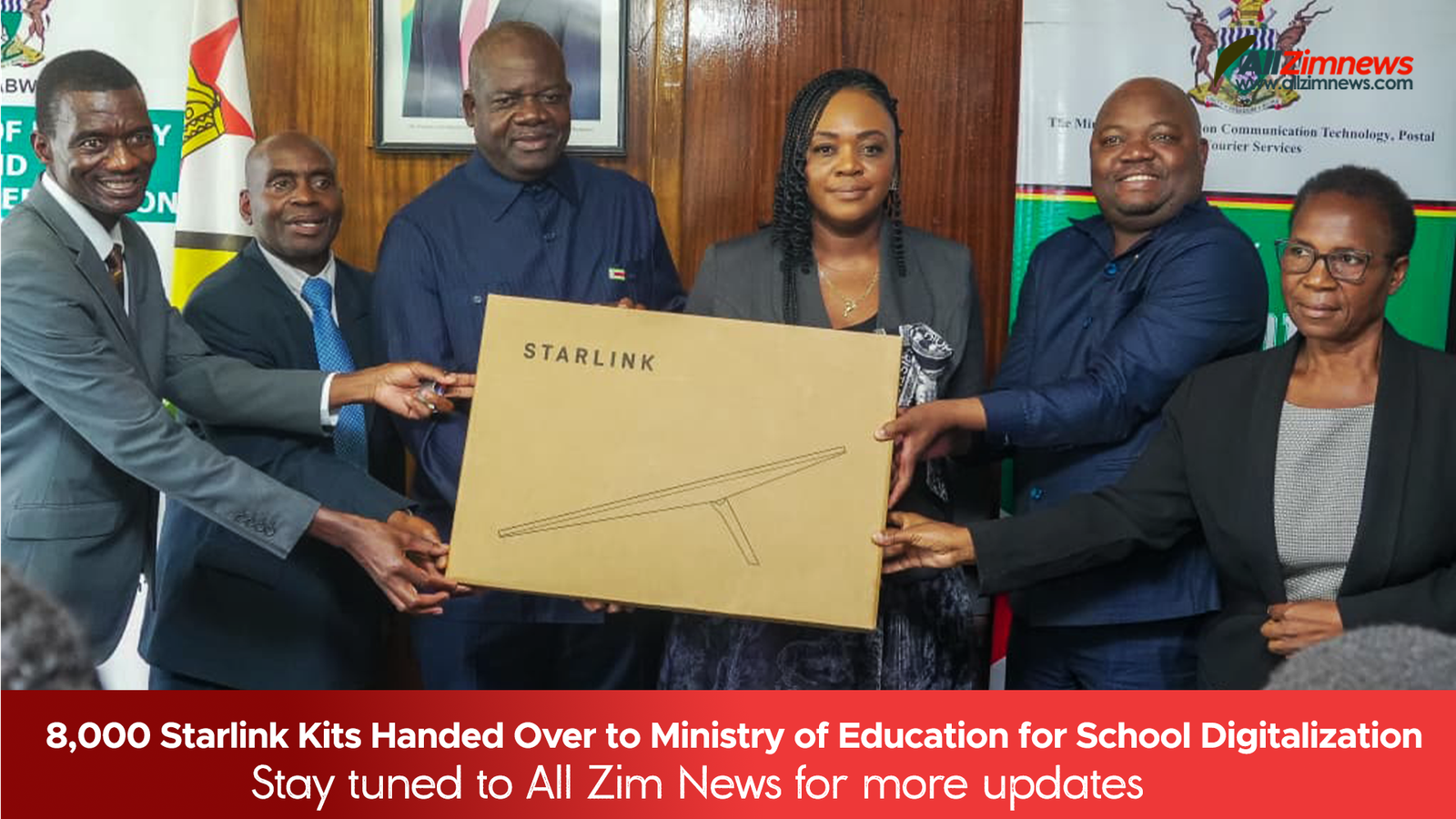
The government on Wednesday began a nationwide push to expand internet access in public schools, handing over thousands of satellite connectivity kits to the Ministry of Primary and Secondary Education in a move officials say is aimed at narrowing long-standing digital gaps between urban and rural learners.
Minister Mavetere presided over the handover of 8,000 Starlink connectivity kits, describing the initiative as a key part of Zimbabwe’s digital transformation agenda and a practical response to limited broadband infrastructure in rural areas. The kits are being transferred to the Ministry of Primary and Secondary Education, represented by Minister Professor Torerayi Moyo.
“This is not a ceremonial exchange,” Minister Mavetere said, calling the programme a strategic intervention designed to integrate digital technology into education delivery across the country. The rollout aligns with the government’s Vision 2030 framework, which prioritizes technology as a driver of economic growth and public sector reform.
For years, uneven connectivity has shaped access to education in Zimbabwe. While schools in major cities such as Harare benefit from relatively stable mobile and fibre networks, many rural schools operate without reliable internet, limiting access to digital learning platforms, online research materials, and teacher development resources.
The Starlink kits, which use low-earth orbit satellites to provide broadband connectivity, are intended to bypass those constraints. According to the Ministry of ICT, the technology will allow schools beyond the reach of fibre or mobile networks to access online classrooms, digital libraries, and real-time educational content.
Minister Mavetere said the government would place emphasis on accountability and outcomes, noting that connectivity alone would not be sufficient. Officials plan to assess the impact of the programme on learner performance, digital literacy levels, and teaching methods.
“We must be able to measure whether this connectivity is improving pass rates and strengthening teaching effectiveness,” the Minister said.
Minister Professor Moyo said the first batch of 100 kits marks the beginning of a phased deployment to schools nationwide. He linked the initiative to broader government programmes, including the Presidential Internet Scheme, school computerisation, and the solarisation of rural schools.
“Reliable internet access is no longer a luxury,” Minister Professor Moyo said. “It is a requirement for delivering modern education.”
The connectivity rollout comes as the education sector accelerates implementation of National Development Strategy 2, with a focus on infrastructure development, Science, Technology, Engineering and Mathematics (STEM), and a new heritage-based curriculum. Officials say internet access will support curriculum delivery, vocational education, and the introduction of digital skills such as coding, robotics and artificial intelligence.
Both Ministers said the programme reflects a whole-of-government approach directed by President Emmerson Dambudzo Mnangagwa, with the goal of ensuring equitable access to education regardless of location.
The remaining kits are expected to be distributed to schools across the country in phases, with priority given to institutions in remote districts that have historically lacked connectivity.
